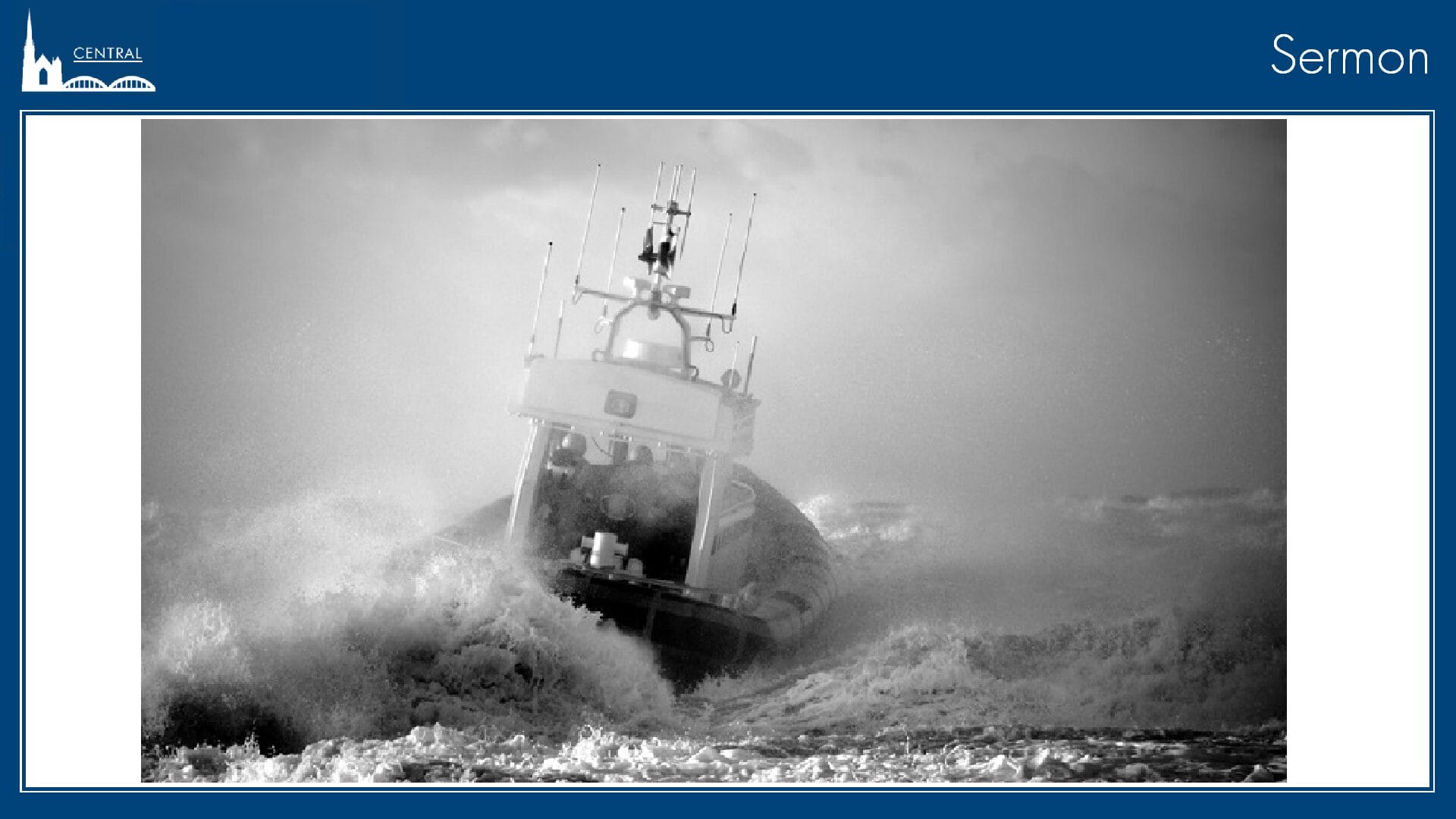
In The Storm

In the Middle of the Storm

Acts 2

The Holy Spirit Comes at Pentecost

When the day of Pentecost came, they were all together in one place. Suddenly a sound like the blowing of a violent wind came from heaven and filled the whole house where they were sitting. They saw what seemed to be tongues of fire that separated and came to rest on each of them. All of them were filled with the Holy Spirit and began to speak in other tongues[a] as the Spirit enabled them.

Now there were staying in Jerusalem God-fearing Jews from every nation under heaven. When they heard this sound, a crowd came together in bewilderment, because each one heard their own language being spoken. Utterly amazed, they asked: “Aren’t all these who are speaking Galileans? Then how is it that each of us hears them in our native language? Parthians, Medes and Elamites; residents of Mesopotamia, Judea and Cappadocia, Pontus and Asia,[b] 10 Phrygia and Pamphylia, Egypt and the parts of Libya near Cyrene; visitors from Rome 11 (both Jews and converts to Judaism); Cretans and Arabs—we hear them declaring the wonders of God in our own tongues!” 12 Amazed and perplexed, they asked one another, “What does this mean?”

13 Some, however, made fun of them and said, “They have had too much wine.”

Peter Addresses the Crowd

14 Then Peter stood up with the Eleven, raised his voice and addressed the crowd: “Fellow Jews and all of you who live in Jerusalem, let me explain this to you; listen carefully to what I say. 15 These people are not drunk, as you suppose. It’s only nine in the morning! 16 No, this is what was spoken by the prophet Joel:

17 “‘In the last days, God says,
    I will pour out my Spirit on all people.
Your sons and daughters will prophesy,
    your young men will see visions,
    your old men will dream dreams.
18 Even on my servants, both men and women,
    I will pour out my Spirit in those days,
    and they will prophesy.
19 I will show wonders in the heavens above
    and signs on the earth below,
    blood and fire and billows of smoke.
20 The sun will be turned to darkness
    and the moon to blood
    before the coming of the great and glorious day of the Lord.
21 And everyone who calls
    on the name of the Lord will be saved.’[c]

22 “Fellow Israelites, listen to this: Jesus of Nazareth was a man accredited by God to you by miracles, wonders and signs, which God did among you through him, as you yourselves know. 23 This man was handed over to you by God’s deliberate plan and foreknowledge; and you, with the help of wicked men,[d] put him to death by nailing him to the cross. 24 But God raised him from the dead, freeing him from the agony of death, because it was impossible for death to keep its hold on him. 25 David said about him:

“‘I saw the Lord always before me.
    Because he is at my right hand,
    I will not be shaken.
26 Therefore my heart is glad and my tongue rejoices;
    my body also will rest in hope,
27 because you will not abandon me to the realm of the dead,
    you will not let your holy one see decay.
28 You have made known to me the paths of life;
    you will fill me with joy in your presence.’[e]

29 “Fellow Israelites, I can tell you confidently that the patriarch David died and was buried, and his tomb is here to this day. 30 But he was a prophet and knew that God had promised him on oath that he would place one of his descendants on his throne. 31 Seeing what was to come, he spoke of the resurrection of the Messiah, that he was not abandoned to the realm of the dead, nor did his body see decay. 32 God has raised this Jesus to life, and we are all witnesses of it. 33 Exalted to the right hand of God, he has received from the Father the promised Holy Spirit and has poured out what you now see and hear. 34 For David did not ascend to heaven, and yet he said,

“‘The Lord said to my Lord:
    “Sit at my right hand
35 until I make your enemies
    a footstool for your feet.”’[f]

36 “Therefore let all Israel be assured of this: God has made this Jesus, whom you crucified, both Lord and Messiah.”

37 When the people heard this, they were cut to the heart and said to Peter and the other apostles, “Brothers, what shall we do?”

38 Peter replied, “Repent and be baptized, every one of you, in the name of Jesus Christ for the forgiveness of your sins. And you will receive the gift of the Holy Spirit. 39 The promise is for you and your children and for all who are far off—for all whom the Lord our God will call.”

40 With many other words he warned them; and he pleaded with them, “Save yourselves from this corrupt generation.” 41 Those who accepted his message were baptized, and about three thousand were added to their number that day.

The Fellowship of the Believers

42 They devoted themselves to the apostles’ teaching and to fellowship, to the breaking of bread and to prayer. 43 Everyone was filled with awe at the many wonders and signs performed by the apostles. 44 All the believers were together and had everything in common. 45 They sold property and possessions to give to anyone who had need. 46 Every day they continued to meet together in the temple courts. They broke bread in their homes and ate together with glad and sincere hearts, 47 praising God and enjoying the favor of all the people. And the Lord added to their number daily those who were being saved.

Transcript

(Transcribed by TurboScrib)

Welcome to Central. Those that you see around here are the ones that are left behind. The rapture had taken place, and we are the left behind.

So you got to hang in there with me for another while. It is good to see you. If you don't know, Central is a Jesus church where everyone is welcome, where no one is perfect, but where everyone is loved, and where anything is possible.

Father God, in these moments, as we open the word, and we listen for your word, may you take away everything else. And as your word says, may we see Jesus, and only Jesus. Forgive your servant, Lord, for his sins are many.

But will you appear, and will you speak? In Jesus' name we pray, amen. Marriage and family therapist, Paul Faulkner, tells a story of how he helped a couple to adopt a teenage girl, a rebellious young woman, because of all the hurt and the things that happened in her life. But this couple just fell in love with this young woman and said, we want to adopt her.

So they got the papers ready, and while they're waiting for it to finalise, they took her home, and she stayed with them. One day, the father came home and found the house ransacked, and some jewellery missing, and some money. Family friends immediately said to him, stop the process, don't adopt this girl, it's not too late, stop.

And the dad looked at them, and he said, it is too late. And they're saying, what do you mean it is too late? He says, because I have already told her that she is my daughter. I tell you this story, because it's our story.

You're going to hear that again this morning. God, God in his great love and his great grace, call you and me his children. And nothing you do, nothing you've done, nothing you will do, will ever change that.

You are his child. And he did that when we were like that young woman, rebellious sinners, turning our back, running away, messing the house up, stealing the food, stealing the money, stealing everything. And God said, I'm going to make a covenant with you.

Oh, that's a big old church word, let's change that. I'm going to make this contract with you, that you are my children, and nothing can change that. You want to hear that? It comes from Romans chapter 5. See if these glasses work, my others broke this week, so let's see if I can see what's going on.

This week I printed them in 24 points, and even with the glasses that small. Listen to this beautiful, and Dave said to me this morning, it's one of the passages his dad made him memorise. When we were utterly helpless orphans, Christ came just at the right time and died for us rebellious, naughty, runaway sinners.

Now, most people would not be willing to die for an upright person, though someone might perhaps be willing to die for a person who is especially good. And now comes your biblical but, and this is about God. But God, but God showed his great love for us by sending Christ to die for us while we were still sinners.

When we were utterly helpless, God, because of his great love for us, sent Christ to die for us while we were still sinners. What an amazing word. See here's the thing, just as that father didn't look at that young woman in her room rebellious ways in this broken house that she left behind in that moment, didn't look at her and say, when you've learned how to behave yourself, then you'll be welcome back in my house.

In the same way, God doesn't look at us with our frazzled, broken lives and say to us, when you're good, when you're perfect, then I'll die for you. In the same way, David did not look at Mephibosheth and say, once you're able to stand on your own two feet, I'll rescue you. And I see the question marks, Mephibosheth, who? Well, you're in for a good story this morning of God's grace in our lives.

Let me tell you about Mephibosheth. I should do the Tim Hortons thing again this morning and see who gets this one. Mephibosheth, so first king of Israel was a man called Saul.

Saul had a son. His son's name was Jonathan. Jonathan had a son.

His son's name was Mephibosheth, would be the first heir after Jonathan to come on the throne if Jonathan were to pass away. So happened that Saul and Jonathan went to war against the Philistines from Gaza, Asdot, and they fought in Jezreel, and Saul and Jonathan were both killed. This meant that David, who had already been anointed, would become the next king, but he was not of the lineage of Saul.

So what usually happened, when a new king came to the throne and he wasn't of the same lineage, that king would kill all of the descendants of the other king so that at some stage later someone couldn't come up and say, oh, oh, I'm actually the real heir. I'm the king. So they made sure that there's no one that could do that.

They killed them all. Now David was never going to do that. Some of his soldiers didn't know that, so they started killing some of the descendants, and David immediately stopped that.

Actually, he executed those who did that to say, that's what's going to happen. You leave it alone. Now Jonathan and Saul's people who took care of the kids did not know that, and that's where we pick up the story in 2 Samuel chapter 4. Just one verse going to read that.

So Saul's son, Jonathan, had a son named Mephibosheth. If you read the book of Chronicles and they talk about him, he's called Meribald, same guy. So he had a son named Mephibosheth, and remember this word, who was crippled as a child.

He was five years old when the report came from Jezreel that Saul and Jonathan had been killed in battle. When the child's nurse heard the news, she picked him up and fled, and here's your biblical but. But as she hurried away, she dropped him, and he became crippled.

There's that word again. Hold on to it for a second. Now if this story of Mephibosheth in this moment sounds familiar, it's because it is.

And you're thinking, why? I'll tell you why. Because we have a lot more in common with Mephibosheth than we think. Both he and I, and us, are from royal descent.

You know that, right? Paul, you're frowning. Who's your father? No. Who's your father? Who's your father? And what is he? He's the king of kings and the lord of lords.

What does that make you? Makes you a royal son, a prince, and a princess. Will you remember that, please? You're not a nobody. You're a somebody.

Your dad's the king of the universe. You can walk proud on that. Like Mephibosheth, we worship the one, the only living God who loves us, who cares for us, who provides for us.

Like Mephibosheth, we too have fallen and carry the scars of the fall that happened way back there in the Garden of Eden. And to this day, those scars of the fall still pursue us and some days get us under a little bit. And some days, a little like Mephibosheth, we wonder and we're scared to go into the presence of the king.

Now, in the meantime, let me get back to the story. David's kingdom grew and it was a strong kingdom and he brought peace. It multiplied.

It was 10 times the size that it was when he inherited this kingdom. And in this time, David remembered a promise that he made to Jonathan because if you remember the stories, David and Jonathan were BFFs. Nothing could separate the two.

But there was a moment in which Saul, Jonathan's dad, wanted to kill David because he heard that David had been anointed as king. So he wanted to get rid of him and Jonathan said, I'm going to help you. I'll let you know what my dad's going to do.

But I want you to make me a promise. You can read this in 1 Samuel chapter 20. I want you to make me a promise that you will always, always take care of my family.

David remembered that promise. That he promised Jonathan that he would take care of his family. So there's our scripture reading for today.

At last, I get to it. 2 Samuel chapter 9 verse 1. So David asked, is there anyone still left of the house of Saul to whom I can show kindness for Jonathan's sake? This is such a beautiful moment. If you think of your own life in those moments in which you've received grace, wasn't it that moment in which your heart would also jump and say, I can't just take this for myself.

I need to share this grace. I need to give this grace to others too. And this is one of those moments that's happening here in David's heart.

He's not doing this to make a political move. He's not doing this to get any applause. This is David's heart.

The heart that God planted in that man that messed up so badly, but God loved so dearly that he called him a man to his own heart. This gentle side, the side that says, can I share? Can I give of that grace that I have received so freely? May I bless you with that grace too. Is there someone that I can bless? Now there was a servant of Saul's household named Ziba.

They summoned him to appear before David. And the king said to him, Are you Ziba? At your service, he replied. The king asked, Is there no one still alive from the house of Saul to whom I can show God's kindness? And Ziba answered the king, There is still a son of Jonathan.

Now look, here it comes again. He's lame in both feet. Where is he? The king asked.

And Ziba answered, He's at the house of Mekir, the son of Amiel in Lodabar. Yes, yes, there is. There is a son.

His name is Mephibosheth, but he's lame in both feet. And he lives in this desolate, horrible place called Lodabar. That's a beautiful Hebrew.

And you know, I teach you Hebrew and Greek. So here's your Hebrew lesson for the day. Lodabar in Hebrew always means no or not.

And Dabar is word. So this place where we don't speak of it, no words. We don't talk of this place.

It's so horrible. It's so desolate. It's such a bad place.

And that's where Jonathan, that's where Mephibosheth is living. Jonathan's son in this place of ruin. I said to you notice the three times the designation for Mephibosheth.

He was crippled. He fell and he was crippled. He has a son and he is lame in his feet.

They don't call him the heir. They don't call him the prince. He's the crippled guy.

Followed him. Oh, oh, I saw John this week. You know, the guy has been divorced three times.

And oh yeah, I ran into to Jack, the alcoholic, you know. And as I was walking into shoppers, I saw Mary. You know, that's the single mom labels.

We carry them and they just follow you wherever you go. And sometimes you just wonder, does anyone see me, just me for who I am? Does anyone see me and not my pain? Does anyone see me and not the struggles in my life? Does anyone see me and not just the mistakes that I have made in my life? Does anyone just see me? Can I tell you something? Right back into the Romans passage. And God saw us.

And when God saw us at the right time, he in his great love sent Jesus. And God sees me and he says, good morning, Alexander. Because he sees me for who I am.

He says, morning, dawn. And he sees me for who I am. Not my past.

Not my mistakes. Not my sins. Me.

Beloved. Child of my father. That's who you are.

And let no one else tell you different. And especially don't allow Satan to cry and play a game with you and say anything else to you. When you look in that mirror, it's okay to see the little things on the eyes and to see the grey hair glowing on the head.

But when you look in that mirror, the first thing you need to say is, man, I love you because you're a child of God. And he loves you unconditionally for who you are. Go home and do that, please.

Because that's who you are. Let me not get carried away. Let me go further with the scripture.

So, verse 5, King David had him brought from Lodabar from the house of Makir, son of Amiel. And when Mephibosheth, son of Jonathan, the son of Saul, came to David, he bowed down to pay him honour. And David said, Mephibosheth, at your service, he replied.

Don't be afraid, David said to him. For I will surely show you kindness for the sake of your father, Jonathan. I will restore to you all the land that belonged to your grandfather, Saul.

And you will always eat at my table. And so Mephibosheth ate at David's table like one of the king's own sons. Oh, my goodness.

What a story of grace. Here Mephibosheth comes in humility and a little scared at your service. He needs that little assurance.

Am I going to be okay? Is he bringing me for the last meal? And then he's going to take me to the gallows and get rid of me. I'm not so sure about that. And what does David call him? He doesn't call him the guy who can't stand on his own feet.

He calls him, you're going to be like one of my sons. You're going to sit at my table. Because that's who you are.

And sometimes we need a little assurance too, right? So here's the thing. If you need assurance, go to the cross and just look at the cross. Can I remind you of the Romans passage again? Because of his great love, God sent Jesus to die for us when we were still rebellious, runaway, wild sinners.

If you wonder how God sees you, look at the cross and see Jesus with his arms wide open. Look at the cross and see the wounds that will never be yours. Because for us, he was broken.

Look at the cross and see the blood that washes you and cleanses you and makes you brand new. That you can stand and look up at your father and say, hello, father, I love you. And he says, hello, child, I love you.

Like Mephibosheth, hear the words when David said to him, don't be afraid. Father says, don't be afraid. Will you please hear that, child of God? Will you please carry that in your heart every day? Will you please remember that you can go to father God and you do not have to be afraid.

You do not have to come in there crawling because you're his child. You can just go in there. So here's the thing.

This is the church of Mephibosheth, God's church, where everyone is welcome. As messed up as you are. Boy, you can't be more messed up than me.

Where no one is perfect. Thank God for that. Because all we can do then is help each other.

Where everyone is loved because we've been touched by the love of Jesus Christ and we have been changed forever. So it's so easy to love. And where anything is possible.

So, good morning, my fellow Mephibosheth. Welcome at the table of your father. Amen.

Take a few moments of silent prayer. How do we say thank you, father? The word sounds so, so small. But you understand when we say thank you.

Thank you for not putting labels on us. The only label that we have is child of the almighty God. Thank you, father, for not giving up on us.

You could have so easily just wiped us off the face of the earth. But you didn't because of your great love. Because of your great love, Lord Jesus, you left your kingdom and became one of us.

Thank you. We love you, father. We love you so much.

Thank you for teaching us. Thank you for your patience with us. Thank you for your grace.

That amazing grace that knows no boundaries. We live of that. So thank you, Lord, that you use us also to become instruments of grace like David did.

May we, Lord, just take this grace and live it in such a way that lives are touched and lives are changed. Thank you that we may sit at your table and be called your children. We love you with all that is in us as we pray in the name of Jesus.

Amen.

Return to Sermons

Privacy Overview

This website uses cookies so that we can provide you with the best user experience possible. Cookie information is stored in your browser and performs functions such as recognising you when you return to our website and helping our team to understand which sections of the website you find most interesting and useful.