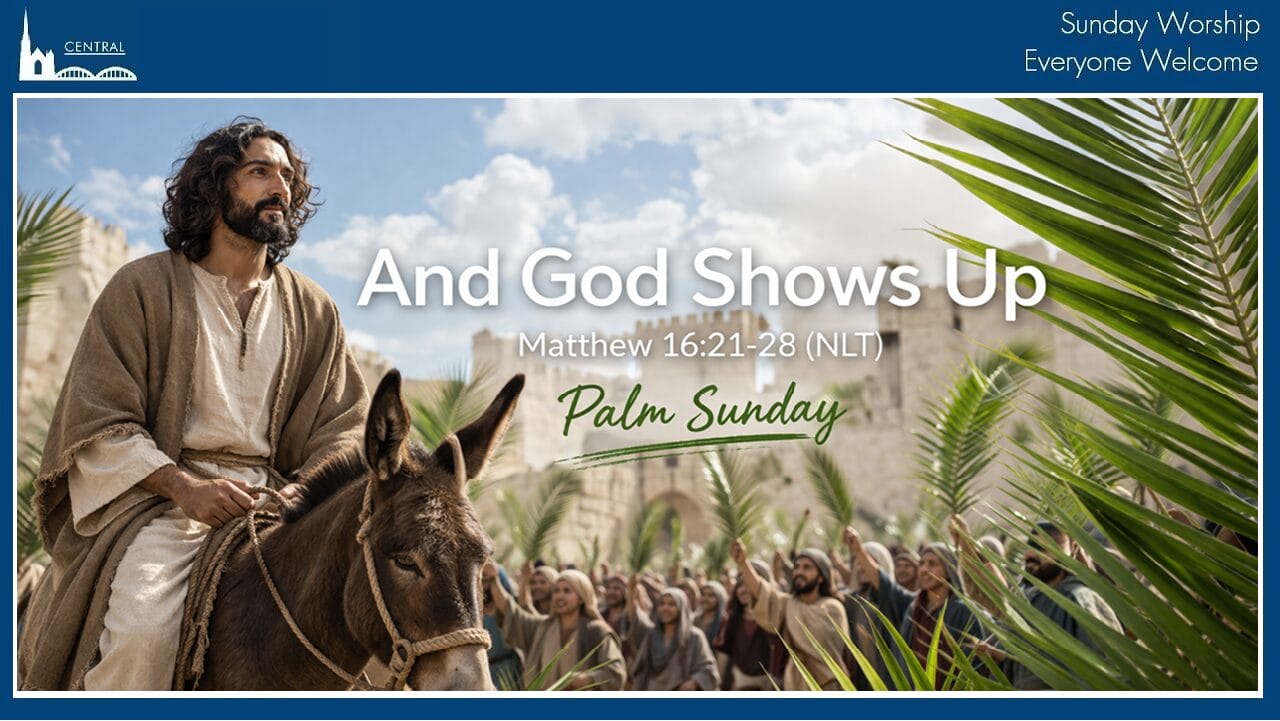
Palm Sunday Service Banner Matthew 16:21-28

Matthew 16:21-28 (NLT)

Jesus Predicts His Death

21 From then on Jesus[a] began to tell his disciples plainly that it was necessary for him to go to Jerusalem, and that he would suffer many terrible things at the hands of the elders, the leading priests, and the teachers of religious law. He would be killed, but on the third day he would be raised from the dead.

22 But Peter took him aside and began to reprimand him[b] for saying such things. “Heaven forbid, Lord,” he said. “This will never happen to you!”

23 Jesus turned to Peter and said, “Get away from me, Satan! You are a dangerous trap to me. You are seeing things merely from a human point of view, not from God’s.”

24 Then Jesus said to his disciples, “If any of you wants to be my follower, you must give up your own way, take up your cross, and follow me. 25 If you try to hang on to your life, you will lose it. But if you give up your life for my sake, you will save it. 26 And what do you benefit if you gain the whole world but lose your own soul?[c] Is anything worth more than your soul? 27 For the Son of Man will come with his angels in the glory of his Father and will judge all people according to their deeds. 28 And I tell you the truth, some standing here right now will not die before they see the Son of Man coming in his Kingdom.”

Transcription

(Transcribed by TurboScribe)

Palm Sunday begins on a road leading to Jerusalem. A king enters the city, not with armour, not with force, but on a donkey. Palms wave in the air like declarations of victory.

Voices cry, Hosanna, blessed is he who comes in the name of the Lord. They were celebrating a king, but didn't understand the kind of king he was. Because this celebration is moving somewhere.

The cheers of Sunday are already casting the shadow of Friday. This same road leads to a cross. Palms will give way to thorns.

Shouts will fall silent beneath the weight of nails. Yet this is not a story of loss. It's a story of love.

Because the cross was never the end. It was the doorway. Palm Sunday leans toward an empty tomb.

Toward a morning where death is defeated and hope rises with the sun. The king who came in humility will rise again in victory. Good morning.

It's good to see so many of you and to see your faces on this Palm Sunday. Alexander just said he forgot to remind you that there is a Maundy Thursday service, but it's online only. So if you go to the website, it will be online and you can watch the Manndy Thursday service online.

Father God, thank you for these moments, moments in your holy presence. We'll hear your words again this morning, Lord Jesus, as you remind us why you came into this world. Help us then to see you and honour you.

In your holy name we pray. Amen. I'm sure you'll agree with me if I say that this amazing life that God gives us, with all of its joy and happiness and also sometimes with a struggle, isn't always easy and sometimes really painful.

There's many reasons for that. We suffer loss. We struggle.

We fail. We get angry. We get frustrated.

All of these things and it causes pain. But maybe the most difficult of all of these challenges is the pain of surrender. That moment that I stand before God and I look God in the eye and I say, Lord, here's my everything, my whole life, and I want to give that to you in a surrender.

And from now on, Lord, you lead and I will follow. Because just think, most of us like to lead. Most of us like to make the decisions.

Most of us like to be in control. And all we want of God is to follow behind and clean up the messes. So the question we're going to ask this morning, and each of us has to answer that for themselves, is the question in my life, who leads and who follows? It's a little bit of the question of Palm Sunday.

Because for Jesus to get to that open grave, he had to surrender. And it started on Palm Sunday. So read with me Matthew 16.

That was interesting. When I saw this, my last sermon here before I went off was from Mark, and it was the same passage, not the same sermon. So Caesarea Philippi is where they are.

You'll remember that, where Jesus asked the question, who do you say I am? And then we go in Matthew from verse 21, and I'm reading from the New Living Translation. From then on, Jesus began to tell his disciples plainly that it was necessary for him to go to Jerusalem and that he would suffer many terrible things at the hands of the elders. Presbyterians, you know that.

The word for elder in Greek is presbyteros. He didn't suffer by the presbyterians. By the hands of the elders, the leading priests, and the teachers of religious law.

He would be killed, but, and that is a big biblical but. He would be killed, but on the third day, he would be raised from the dead. But Peter took him aside and began to reprimand him for saying such things.

Heaven forbid, Lord, he said, this will never happen to you. Jesus turned to Peter and said, get away from me, Satan. You're a dangerous trap to me.

You're seeing things merely from a human point of view, not from God's. And then Jesus said to his disciples, who wants to lead, who wants to follow? If any of you want to be my follower, you must give up your own ways. Take up your cross and follow me.

For if you try to hang on to your life, you will lose it. But if you give up your life for my sake, you will save it. So what do you benefit if you gain the whole world, but you lose your own soul? Is anything worth more than your soul? For the Son of Man will come with His angels in the glory of His Father and will judge all people according to their beliefs.

And I tell you the truth, some standing here right now will not die before they see the Son of Man coming in His glory. So here we have Jesus in this discussion with His disciples, telling them what's waiting for them as they journey to Jerusalem. For what they'll see in a moment is they'll go in there and they'll hear the Hoshana, save us, Lord.

They'll hear what we just sang. Blessed is he who comes in the name of the Lord. Baruch haba b'Shem Adonai.

Blessed is the one who comes in the name of the Lord. They're going to hear all of this, and they're going to see this King. And Jesus says, stop.

Let me tell you what's really going to happen when you see all this. I'm going to Jerusalem because I am surrendering to the plan of God. I'm going there, and they will take me prisoner, and they are going to torture me, and I am going to suffer, and they are going to nail me to a cross, and I am going to die.

But on the third day, God is going to let me walk out that tomb. And when you read this, and when you go read it again, you'll see that when Jesus says this, you cannot feel in the language that there's regret or a heaviness or, oh, my Holy Moses, why am I having to go and do this? Yes, He says, it's going to be hard. Yes, it's going to be difficult.

I am going to suffer. I am going to be nailed to a cross. I am going to die.

But, and there's that big biblical but, on that third day, God is going to show up, and I am going to walk right out of that grave. Can you hear that, my friends? What He's saying is this, if I am prepared to surrender and give it up to God, God will show up on the third day. Sometimes the third day is longer than three days.

Sometimes the third day feels like it's never going to happen. And Satan will stand, as he did outside the tomb of Jesus, and he was celebrating because he's gone and dead. And on that third day, God says, arise, my love, arise, my love.

Death no longer has a hold on you. And Jesus says to you and me, if you surrender your life to me, and you give it up, and I lead, and you follow, whatever it might be, there is a third day, and on the third day, God shows up. Is there any Baptist in this church that can say amen? Because that God that shows up is a good God, and a loving God, and a caring God, a God who knows me, and a God who gave His only Son for me.

If I surrender, God shows up. Always. And this is not a biblical, well maybe it is, biblical, but this is one of ours.

It's a causal relationship. Jesus, being obedient and going to the cross, causes God to show up and open that grave. If Jesus did not go to the grave and give it all up, there would be no third day.

Not for Him, not for me, not for you, and not for anyone. When I surrender, God shows up. Didn't sit well with Peter.

By now we should know that. And Peter has a word to say. In that beautiful verse 22, Peter took him aside and said, Heaven forbid, Lord, that would never happen to you.

Now, if it wasn't so serious, we could have a little chuckle out of this. Because just think about it. Here's Peter looking at the Son of God, trying to stop the Son of God from doing what the Son of God had come to do in this world from the beginning.

The irony is also a little sad. Peter, in doing this and just being so in a hurry, he misses, doesn't see what it means for God to show up. Because Peter's doing the Peter thing and the us thing.

Peter's looking out for Peter's own interests. He's thinking, Jesus, we've got a good thing going. Look at all the people with us.

They're just coming. We're going to Jerusalem. It's the feast.

Do you know how we can build that congregation? Do you know how we can build this movement? We've got a good thing going. Don't you talk about dying and stuff like that. Because here's the thing.

Peter's looking out for Peter's best interest. And the problem is so many of us fall into that same trap. And we think, if I lead, if I do the things, if I stay in command, if I do, then I'll be fine.

Because it's for my best interest. How sad the answer that Jesus gives him. And no wonder Jesus is a little sharp in his answer.

Because in doing what Peter is doing, he's violating the most fundamental characteristic of God. Of who God is. Of who God works.

Of how God functions in this world. And that is that God is always looking out for the best interest of others. When this world was messed up, he called the Noah.

And he started over. When he needed to start out new, he called the man Abraham from Ur. And brought him all to the promised land.

When things were not good, he sent a young man called Joseph. And three days was a little longer for him. But that was in preparation for him to show up when they needed him.

Took a little baby and put him in the River Nile. Because God did show up for our best interest. He called prophet after prophet.

He sent a man called John the Baptizer. And he sent his son. Problem is, when we start looking out only for our own interest.

When we try and do things for ourselves and just manipulate and make them work as we think they should be working. Oftentimes we end up living in the wrong stories. And I think I'm great.

And when I'm not doing great, I'm kind of angry at God. Why? Because I'm living in the wrong story. I've told you this story before, but it's a really good illustration of this.

There's a story of the couple who were married 60 years. They decided to downsize. And as they were going through the house, the husband discovers this little box.

Way back in the cupboard. Opens the box. There's two beautiful crochet dolls in the box.

And then there's also this envelope with $90,000 in it. And he's kind of stunned. So he walks in.

He says, look what I discovered. Do you know anything about this? He says, yeah. It's all me.

He says, tell the story. He says, well, when we got married, my grandmother called me. And she said, I want to give you some advice for your marriage.

When you get into a fight, don't fight. Go to your room. Go calm down and crochet a doll.

And just put it away. Put all the anger away with the doll. And he looked at this box.

And he thought, wow. In 60 years. He says, that's good.

But what about the $90,000? She said, well, after the second doll, I didn't have any more room for the dolls I crocheted. So I took them to the craft store and sold them for $5. He was living in the wrong story.

And sometimes we live in the wrong story. So I ask myself, what if I'm living in the wrong story? What if I'm living in the wrong story when I'm trying to take control and I'm not waiting for God to show up on that third day? What if I'm running after this world because the world says, this is what you should be doing. This is what you should be running after.

You want it all. You want it now. And if you don't get it now, then fine with you.

I'm going to do my own thing. What if Jesus says, verse 25, if you try to hang on to your life, you will lose it. But if you follow me and you give up your life for my sake, you will save the world.

Why? Why should I give up my life? Because in that moment that I surrender is when God shows up. God's power is not seen by our control in our lives. God did not raise Jesus because Jesus shied away from the cross.

God raised Jesus from the dead because Jesus was obedient and went to the cross. And on that third day, God showed up and Jesus walked. My question in the beginning was, who lives, who falls in my life? Can we just for a moment look at our own lives and ask the question in my life, have I surrendered? Who's in control when I get angry? Who's in control of my finances? Who's in control of my relationships? Who's in control of the emotions? Who's in control when I feel this world is overwhelming? Who lives? When you've answered that and when I've answered that, because remember what I've always said, every sermon I write is written for this person.

And then I come share it with you on my own life. So I ask these questions of myself. So here's my challenge for me, for us this morning.

Will you surrender? Will you take all of the things in your life, also the control, also the things that you're afraid of, also the things that you're not sure that you can let go, can you take those? And can we put them in the hands of our Father? The one who sent His Son into this world. The one who turned His back when His Son cried out, my God. And then the one who showed up on that third day and He opened that door.

Can we place it in the hands of the Lord and surrender? There's a song that we sing, I surrender all. I surrender all, all to Jesus. Will you take that? I'm going to give you a moment before I pray with you, just to think about what in my life is there that might, instead of helping me because I'm trying to control it, it's hurting me.

What is there in my life that this morning I can come and lay at the feet of Jesus and say, I surrender. You lead, I follow. I'm scared because it might lead to Jerusalem and there might be an angry mob and there might be the cross, but on the other side there's an open grave.

This is my Lord, I surrender. Take a moment and be quiet with the Lord and then I'll pray with you. Lord Jesus, when you invite us, your promises are never empty.

You've kept them all and you've fulfilled them all, more than we could ever think. And if you, if you come and you say, this is what I call you, surrender. Use your life, follow me.

I have more than you could ever think. We trust you. And you heard our hearts this morning.

As we just surrender, Lord, what needs to go to you. Thank you that you lead. Thank you that we may follow.

Sorry that sometimes we stumble and we take our own road and kind of want to do the Peter thing for a moment. Thank you that you are gracious because that is who you are. Thank you for the blessing of this morning.

Thank you for this blessing of this day. All these things we pray in the name of him who came in the name of the Lord, the one who can and did save us. Jesus, our Lord, our Saviour.

Amen.

Transcript

(Transcribed by TurboScrib)

Welcome to Central. Those that you see around here are the ones that are left behind. The rapture had taken place, and we are the left behind.

So you got to hang in there with me for another while. It is good to see you. If you don't know, Central is a Jesus church where everyone is welcome, where no one is perfect, but where everyone is loved, and where anything is possible.

Father God, in these moments, as we open the word, and we listen for your word, may you take away everything else. And as your word says, may we see Jesus, and only Jesus. Forgive your servant, Lord, for his sins are many.

But will you appear, and will you speak? In Jesus' name we pray, amen. Marriage and family therapist, Paul Faulkner, tells a story of how he helped a couple to adopt a teenage girl, a rebellious young woman, because of all the hurt and the things that happened in her life. But this couple just fell in love with this young woman and said, we want to adopt her.

So they got the papers ready, and while they're waiting for it to finalise, they took her home, and she stayed with them. One day, the father came home and found the house ransacked, and some jewellery missing, and some money. Family friends immediately said to him, stop the process, don't adopt this girl, it's not too late, stop.

And the dad looked at them, and he said, it is too late. And they're saying, what do you mean it is too late? He says, because I have already told her that she is my daughter. I tell you this story, because it's our story.

You're going to hear that again this morning. God, God in his great love and his great grace, call you and me his children. And nothing you do, nothing you've done, nothing you will do, will ever change that.

You are his child. And he did that when we were like that young woman, rebellious sinners, turning our back, running away, messing the house up, stealing the food, stealing the money, stealing everything. And God said, I'm going to make a covenant with you.

Oh, that's a big old church word, let's change that. I'm going to make this contract with you, that you are my children, and nothing can change that. You want to hear that? It comes from Romans chapter 5. See if these glasses work, my others broke this week, so let's see if I can see what's going on.

This week I printed them in 24 points, and even with the glasses that small. Listen to this beautiful, and Dave said to me this morning, it's one of the passages his dad made him memorise. When we were utterly helpless orphans, Christ came just at the right time and died for us rebellious, naughty, runaway sinners.

Now, most people would not be willing to die for an upright person, though someone might perhaps be willing to die for a person who is especially good. And now comes your biblical but, and this is about God. But God, but God showed his great love for us by sending Christ to die for us while we were still sinners.

When we were utterly helpless, God, because of his great love for us, sent Christ to die for us while we were still sinners. What an amazing word. See here's the thing, just as that father didn't look at that young woman in her room rebellious ways in this broken house that she left behind in that moment, didn't look at her and say, when you've learned how to behave yourself, then you'll be welcome back in my house.

In the same way, God doesn't look at us with our frazzled, broken lives and say to us, when you're good, when you're perfect, then I'll die for you. In the same way, David did not look at Mephibosheth and say, once you're able to stand on your own two feet, I'll rescue you. And I see the question marks, Mephibosheth, who? Well, you're in for a good story this morning of God's grace in our lives.

Let me tell you about Mephibosheth. I should do the Tim Hortons thing again this morning and see who gets this one. Mephibosheth, so first king of Israel was a man called Saul.

Saul had a son. His son's name was Jonathan. Jonathan had a son.

His son's name was Mephibosheth, would be the first heir after Jonathan to come on the throne if Jonathan were to pass away. So happened that Saul and Jonathan went to war against the Philistines from Gaza, Asdot, and they fought in Jezreel, and Saul and Jonathan were both killed. This meant that David, who had already been anointed, would become the next king, but he was not of the lineage of Saul.

So what usually happened, when a new king came to the throne and he wasn't of the same lineage, that king would kill all of the descendants of the other king so that at some stage later someone couldn't come up and say, oh, oh, I'm actually the real heir. I'm the king. So they made sure that there's no one that could do that.

They killed them all. Now David was never going to do that. Some of his soldiers didn't know that, so they started killing some of the descendants, and David immediately stopped that.

Actually, he executed those who did that to say, that's what's going to happen. You leave it alone. Now Jonathan and Saul's people who took care of the kids did not know that, and that's where we pick up the story in 2 Samuel chapter 4. Just one verse going to read that.

So Saul's son, Jonathan, had a son named Mephibosheth. If you read the book of Chronicles and they talk about him, he's called Meribald, same guy. So he had a son named Mephibosheth, and remember this word, who was crippled as a child.

He was five years old when the report came from Jezreel that Saul and Jonathan had been killed in battle. When the child's nurse heard the news, she picked him up and fled, and here's your biblical but. But as she hurried away, she dropped him, and he became crippled.

There's that word again. Hold on to it for a second. Now if this story of Mephibosheth in this moment sounds familiar, it's because it is.

And you're thinking, why? I'll tell you why. Because we have a lot more in common with Mephibosheth than we think. Both he and I, and us, are from royal descent.

You know that, right? Paul, you're frowning. Who's your father? No. Who's your father? Who's your father? And what is he? He's the king of kings and the lord of lords.

What does that make you? Makes you a royal son, a prince, and a princess. Will you remember that, please? You're not a nobody. You're a somebody.

Your dad's the king of the universe. You can walk proud on that. Like Mephibosheth, we worship the one, the only living God who loves us, who cares for us, who provides for us.

Like Mephibosheth, we too have fallen and carry the scars of the fall that happened way back there in the Garden of Eden. And to this day, those scars of the fall still pursue us and some days get us under a little bit. And some days, a little like Mephibosheth, we wonder and we're scared to go into the presence of the king.

Now, in the meantime, let me get back to the story. David's kingdom grew and it was a strong kingdom and he brought peace. It multiplied.

It was 10 times the size that it was when he inherited this kingdom. And in this time, David remembered a promise that he made to Jonathan because if you remember the stories, David and Jonathan were BFFs. Nothing could separate the two.

But there was a moment in which Saul, Jonathan's dad, wanted to kill David because he heard that David had been anointed as king. So he wanted to get rid of him and Jonathan said, I'm going to help you. I'll let you know what my dad's going to do.

But I want you to make me a promise. You can read this in 1 Samuel chapter 20. I want you to make me a promise that you will always, always take care of my family.

David remembered that promise. That he promised Jonathan that he would take care of his family. So there's our scripture reading for today.

At last, I get to it. 2 Samuel chapter 9 verse 1. So David asked, is there anyone still left of the house of Saul to whom I can show kindness for Jonathan's sake? This is such a beautiful moment. If you think of your own life in those moments in which you've received grace, wasn't it that moment in which your heart would also jump and say, I can't just take this for myself.

I need to share this grace. I need to give this grace to others too. And this is one of those moments that's happening here in David's heart.

He's not doing this to make a political move. He's not doing this to get any applause. This is David's heart.

The heart that God planted in that man that messed up so badly, but God loved so dearly that he called him a man to his own heart. This gentle side, the side that says, can I share? Can I give of that grace that I have received so freely? May I bless you with that grace too. Is there someone that I can bless? Now there was a servant of Saul's household named Ziba.

They summoned him to appear before David. And the king said to him, Are you Ziba? At your service, he replied. The king asked, Is there no one still alive from the house of Saul to whom I can show God's kindness? And Ziba answered the king, There is still a son of Jonathan.

Now look, here it comes again. He's lame in both feet. Where is he? The king asked.

And Ziba answered, He's at the house of Mekir, the son of Amiel in Lodabar. Yes, yes, there is. There is a son.

His name is Mephibosheth, but he's lame in both feet. And he lives in this desolate, horrible place called Lodabar. That's a beautiful Hebrew.

And you know, I teach you Hebrew and Greek. So here's your Hebrew lesson for the day. Lodabar in Hebrew always means no or not.

And Dabar is word. So this place where we don't speak of it, no words. We don't talk of this place.

It's so horrible. It's so desolate. It's such a bad place.

And that's where Jonathan, that's where Mephibosheth is living. Jonathan's son in this place of ruin. I said to you notice the three times the designation for Mephibosheth.

He was crippled. He fell and he was crippled. He has a son and he is lame in his feet.

They don't call him the heir. They don't call him the prince. He's the crippled guy.

Followed him. Oh, oh, I saw John this week. You know, the guy has been divorced three times.

And oh yeah, I ran into to Jack, the alcoholic, you know. And as I was walking into shoppers, I saw Mary. You know, that's the single mom labels.

We carry them and they just follow you wherever you go. And sometimes you just wonder, does anyone see me, just me for who I am? Does anyone see me and not my pain? Does anyone see me and not the struggles in my life? Does anyone see me and not just the mistakes that I have made in my life? Does anyone just see me? Can I tell you something? Right back into the Romans passage. And God saw us.

And when God saw us at the right time, he in his great love sent Jesus. And God sees me and he says, good morning, Alexander. Because he sees me for who I am.

He says, morning, dawn. And he sees me for who I am. Not my past.

Not my mistakes. Not my sins. Me.

Beloved. Child of my father. That's who you are.

And let no one else tell you different. And especially don't allow Satan to cry and play a game with you and say anything else to you. When you look in that mirror, it's okay to see the little things on the eyes and to see the grey hair glowing on the head.

But when you look in that mirror, the first thing you need to say is, man, I love you because you're a child of God. And he loves you unconditionally for who you are. Go home and do that, please.

Because that's who you are. Let me not get carried away. Let me go further with the scripture.

So, verse 5, King David had him brought from Lodabar from the house of Makir, son of Amiel. And when Mephibosheth, son of Jonathan, the son of Saul, came to David, he bowed down to pay him honour. And David said, Mephibosheth, at your service, he replied.

Don't be afraid, David said to him. For I will surely show you kindness for the sake of your father, Jonathan. I will restore to you all the land that belonged to your grandfather, Saul.

And you will always eat at my table. And so Mephibosheth ate at David's table like one of the king's own sons. Oh, my goodness.

What a story of grace. Here Mephibosheth comes in humility and a little scared at your service. He needs that little assurance.

Am I going to be okay? Is he bringing me for the last meal? And then he's going to take me to the gallows and get rid of me. I'm not so sure about that. And what does David call him? He doesn't call him the guy who can't stand on his own feet.

He calls him, you're going to be like one of my sons. You're going to sit at my table. Because that's who you are.

And sometimes we need a little assurance too, right? So here's the thing. If you need assurance, go to the cross and just look at the cross. Can I remind you of the Romans passage again? Because of his great love, God sent Jesus to die for us when we were still rebellious, runaway, wild sinners.

If you wonder how God sees you, look at the cross and see Jesus with his arms wide open. Look at the cross and see the wounds that will never be yours. Because for us, he was broken.

Look at the cross and see the blood that washes you and cleanses you and makes you brand new. That you can stand and look up at your father and say, hello, father, I love you. And he says, hello, child, I love you.

Like Mephibosheth, hear the words when David said to him, don't be afraid. Father says, don't be afraid. Will you please hear that, child of God? Will you please carry that in your heart every day? Will you please remember that you can go to father God and you do not have to be afraid.

You do not have to come in there crawling because you're his child. You can just go in there. So here's the thing.

This is the church of Mephibosheth, God's church, where everyone is welcome. As messed up as you are. Boy, you can't be more messed up than me.

Where no one is perfect. Thank God for that. Because all we can do then is help each other.

Where everyone is loved because we've been touched by the love of Jesus Christ and we have been changed forever. So it's so easy to love. And where anything is possible.

So, good morning, my fellow Mephibosheth. Welcome at the table of your father. Amen.

Take a few moments of silent prayer. How do we say thank you, father? The word sounds so, so small. But you understand when we say thank you.

Thank you for not putting labels on us. The only label that we have is child of the almighty God. Thank you, father, for not giving up on us.

You could have so easily just wiped us off the face of the earth. But you didn't because of your great love. Because of your great love, Lord Jesus, you left your kingdom and became one of us.

Thank you. We love you, father. We love you so much.

Thank you for teaching us. Thank you for your patience with us. Thank you for your grace.

That amazing grace that knows no boundaries. We live of that. So thank you, Lord, that you use us also to become instruments of grace like David did.

May we, Lord, just take this grace and live it in such a way that lives are touched and lives are changed. Thank you that we may sit at your table and be called your children. We love you with all that is in us as we pray in the name of Jesus.

Amen.

Return to Sermons

Privacy Overview

This website uses cookies so that we can provide you with the best user experience possible. Cookie information is stored in your browser and performs functions such as recognising you when you return to our website and helping our team to understand which sections of the website you find most interesting and useful.