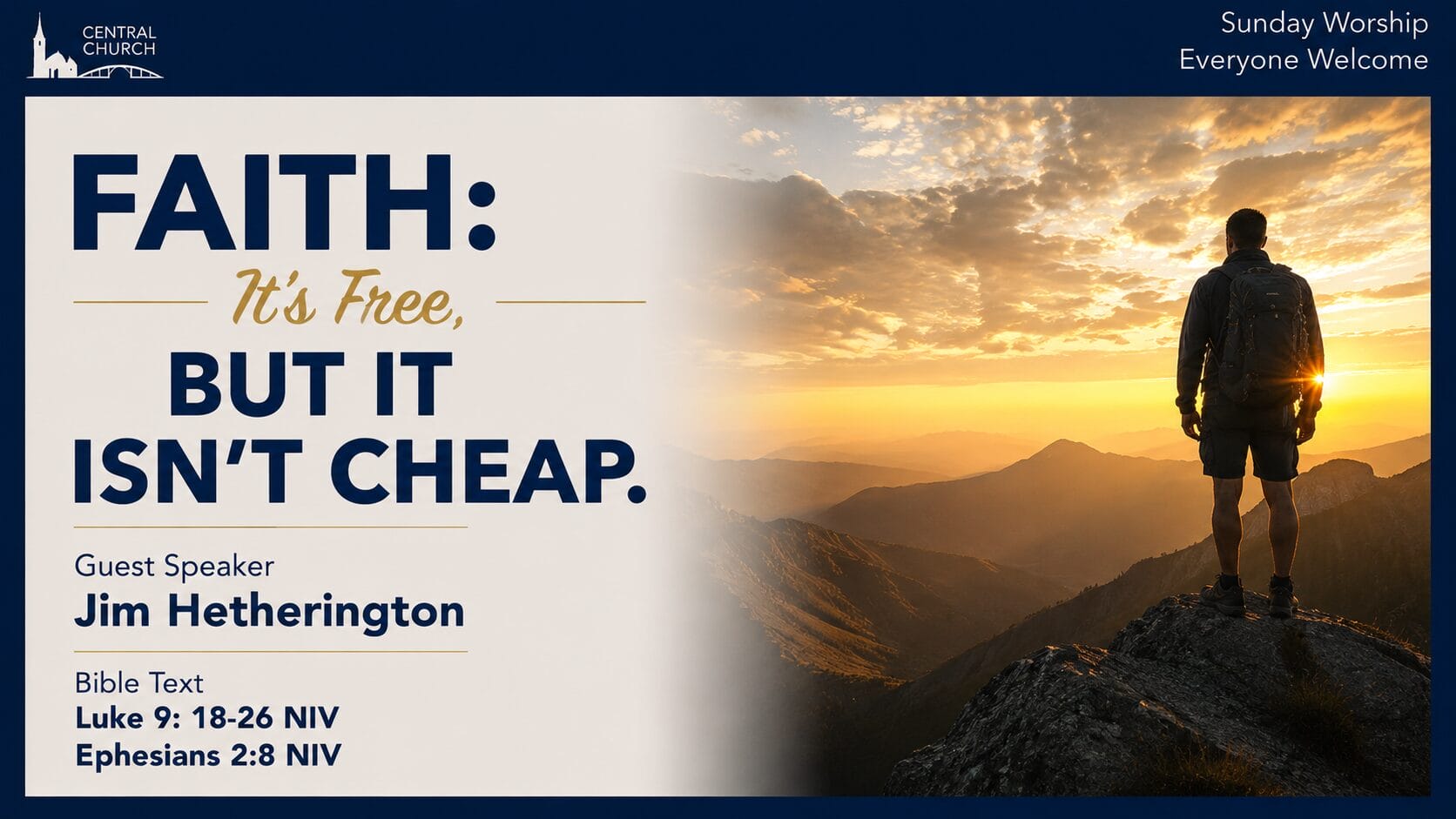
Luke 9:18-26
Peter Declares That Jesus Is the Messiah
18 Once when Jesus was praying in private and his disciples were with him, he asked them, “Who do the crowds say I am?”
19 They replied, “Some say John the Baptist; others say Elijah; and still others, that one of the prophets of long ago has come back to life.”
20 “But what about you?” he asked. “Who do you say I am?”
Peter answered, “God’s Messiah.”
Jesus Predicts His Death
21 Jesus strictly warned them not to tell this to anyone. 22 And he said, “The Son of Man must suffer many things and be rejected by the elders, the chief priests and the teachers of the law, and he must be killed and on the third day be raised to life.”
23 Then he said to them all: “Whoever wants to be my disciple must deny themselves and take up their cross daily and follow me. 24 For whoever wants to save their life will lose it, but whoever loses their life for me will save it. 25 What good is it for someone to gain the whole world, and yet lose or forfeit their very self? 26 Whoever is ashamed of me and my words, the Son of Man will be ashamed of them when he comes in his glory and in the glory of the Father and of the holy angels.
Ephesians 2:8
8 For it is by grace you have been saved, through faith—and this is not from yourselves, it is the gift of God—
Transcript
(Transcribed by TurboScribe)
Just while we're getting ready to worship this morning, again, we're going to be joined by Jim Hetherington, a kale and quinoa salad loving speaker, who is also a Guinness World Record holder. So, we are truly blessed this morning. Jim.
Oh my goodness, the things that people say and talk about. So, I do have to highlight the Guinness World Records attempt. That was so much fun.
I haven't had a chance to share with many of you, so I had this great idea about a year and a half ago to attempt a Guinness World Records attempt. So, what it was, was the most authors in the same book gathered in the same room and signed that book at the same time. So, the current record, or the previous record, was 126, and it was set in Toronto about six years ago, and for some reason, I couldn't be there.
I wasn't able to be a part of it. I always thought it would be a great thing to do, so I started to reach out to Guinness, and there's a lot you got to go through. There's a lot of gatekeepers that you got to go in before you finally get an interview and get to talk with someone, and I think in the email threads, I think in the one email thread, I think I have about almost 80, about 78 emails back and forth.
That's how much dialogue went back and forth, and that's not to mention the adjudicator and the follow-up people and everything, so it was just a lot of work. So, we had 183 people became part of this book. Now, I don't know if you've ever tried to round up 183 people before.
It was a challenge in itself, just to get the content from everybody to put into the book, and so on the day of the event, 142 of them actually showed up and were part of it, and so we had the adjudicator come in, we sat around tables, and we put a copy of the book that everybody was in on the table, and then he went around, verified who they were to make sure they were in the book, so we couldn't just have, you know, Betty come in off the street. She had to be in the book. She had to be part of the book.
We had to make the book available to the public, so 30 days before the event, we had to have it on Amazon, available to the public, so that we could sell copies of it. We had to sell a minimum of 100 copies of the book before the event. I mean, there was just a lot of fun stuff that we had to do, so when he went through and verified everybody, he said, okay, sign, and so everybody signed the book and passed it to the next person around the table, so we ended up with all these books, and so he came out a little bit later after he calculated everything, went with the witnesses that verified it all, and came out and said yes, that we had indeed set a new Guinness World Record of 142 authors signing the same book simultaneously, which was a lot of fun.
It was just a lot of fun, so that's something else I get to add to my resume, which is just so much fun, so anyways, that's not why I'm here. I was looking for the stool of repentance. I know it's hiding here someplace.
I'm going to steal it from, I don't know who was sitting on it, but they're not sitting on it any longer, so I thought I'd start with, this isn't the normal stool, but this will work. This one's padded. This is even better, so I thought I'd start with the stool of repentance because I got a confession to make.
There's three things that I dislike. Wasting energy, wasting time, and wasting money. Anybody in any of those categories with me? I see some hands.
Yes, I see hands going. I bet you it's the money thing, right? Most people are like, oh, I wish I didn't spend it on that. I could have got it five cents cheaper if I wouldn't gone down the street, right? How many here drive, you know, 10 miles to go save two cents on a litre of gas? Anybody want to? Oh, we got a couple.
We got a couple to do this. I think that's hilarious, but you know, just one of those things that I've just noticed over time as I've matured, that's code for old, getting older, as I've matured that, you know, those three things are really valuable and important to me, and I don't know if it's because, you know, we all know we have an expiration date, right? We don't know what that expiration date is, but we know we got one, and I think as we get more mature and a little wiser with our years, we start to look at those things and we say, wow, I gotta stop wasting time. I gotta stop wasting so much money.
I gotta stop wasting so much energy. I mean, how many people here have walked into the kitchen and forgotten what you went in there for, right? Then you have to walk back out again, go back into the room, come back in again, and try it all over again. That's just a waste of energy, isn't it? And say, you know, and with time, you know, with time, I audit my time every once in a while.
Anybody else audit their time occasionally? Oh, I got no, I got no hands. Good, then you're going to enjoy this lesson today. So, I audit my time every once in a while.
I look down, and I started to teach this with my community because I calculated, you know, we got seven days a week, right? Everybody's got seven days. We agree on that. We got 24 hours in a day, right? That equals 168.
So, we got 168 hours every week. So, every once in a while, I'll sit down with my timer. Okay, Jimmy, you got 160 hours.
What did you do with it? And then I'll start to backtrack what I've done, you know, with sleeping and spending time, and, you know, devotions, and reading, and studying, spending time with Mary, doing all those different things, and I begin to calculate it. Well, the first time I did it a number of years ago, I was missing seven hours. Anybody ever lose seven hours of time? I mean, I hunted all over the place trying to figure out where that seven hours went, and I could not figure out where it went.
And I calculated, or recalculated, and went back. I started at the beginning, and came backwards. I started the backwards, and started going forwards, and I could not find it.
Finally, I realised that I was watching a little bit of Netflix, right? How many here love Netflix, or, you know, any of those? I mean, there's some great series on there. There's some great movies. There's some great entertainment, and I love getting into, you know, another story.
I just love stories. I love getting into other stories, and when they come to life in movies, or in dramas, in sitcoms, whatever it is, I just love getting into those things. Well, I discovered I was watching a few extra than I thought I was, right? I was writing down one.
Well, apparently, I was two or three that I was watching, so then I thought, okay, I need to adjust that, so I took that, and I found what that seven hours was, and I adjusted it, and I got going. Earlier this year, I did the same thing. I did another audit, and this isn't, you know, commissioned by CRA or anything.
It was just an audit that I just do on my own, and so I started going through it, and I discovered again. Good old Netflix had snuck back in there, and now, instead of one or two, I was watching two or three, and they go, oh, well, what would happen if I took one of those hours and invested it someplace else? So, I began to do that. I took one hour away from Netflix.
Bad Netflix. I took it away from Netflix, and I started to invest it in doing something different with it, and I began to do this daily. I would just invest this hour into something different, and so in two weeks, I'm going to launch another book.
I was able to write a book going through just stealing an hour back from Netflix and investing it into researching and reading and rewriting and doing all that fun stuff. I've now got my book in. It's getting formatted and ready to come out in a couple weeks, so then I thought, well, I should share this with others, and so in my community, I'm starting a 100 hour sprint, and it's taking one hour and focussing it on something that we want to change, a goal or something we want to achieve, something we want to change, and doing it for 100 days, and so I'm saying that because if you ever thought about something that you want to do or something you want to accomplish, a goal that you're not really achieving, you're welcome to The only cost is the commitment to the time, committing to that one hour and doing that, so if you want to, come up and see me afterwards.
I'll get you the Zoom link. We're just going to meet on Zoom and take people through because I divide my years in quarters. Every three months is a quarter of the year, so September is coming up.
We're going to start this thing, and then October, November, December, that's the last quarter, and that's when businesses want to turn everything around and finish strong, and people look at their goals that they set on January 1st. How many set goals and intentions in January? No confessors on that one. I'm sure there are some that I see a couple hands waving around there.
Yes, okay, and how are those goals working out for you? Oh, you're on track. Good for you. That's amazing.
Good for you because many people, you know, by February or, you know, by the beginning of February, they've lost and they've forgotten about them, but we want to encourage people to finish strong in that last quarter because there's so much that can be accomplished, and I was thinking of some of the mentors that I've had, one in particular. His name is Brian Tracy, and he said that to do a presentation, you need to spend 40 hours, four zero hours, in doing a presentation. That's a lot of commitment, right? I mean, we could all commit right now to becoming vegetarians, and that might last until lunchtime, right, when that juicy hamburger is calling us, right? We can all start things.
We can have good intentions to start things, but the follow-through, to finish it off strong, is a tough thing to do, and I don't think we're meant to do these things on our own. We're meant to have community, have people around us to support and encourage us with that because it's easy to have good intentions, right? You can think back of your own life and your own journey. I'm sure you can think of many times that you've started things and, you know, said, I'm going on that diet.
Yep, supper time's coming. That's the end of the diet, right? You know, I'm going to go healthy. I'm going to start exercising weekly.
It got as far as putting on your running shoes, and that was it. Like, that's as far as you got with it, but to finish strong, I think, is an important thing to do. So, if you want to join us, you can join us because it's one of those things that I really believe is that having the accountability, having people in our lives to encourage and support us, is an important thing to do.
So, that's my confession. You know, those are the three things that I don't like wasting, is time, energy, and finances. This morning, we're going to shift a little bit.
We're going to tie it all together. It'll tie all together as we go, but I wanted to shift and talk about faith because, again, it's something that is free, right? None of us paid for the faith that we have. None of us paid for the relationship we have with God.
None of us have paid for the hours we get every day. None of us have paid any of those things. All that stuff is free, but what we do with it is valuable and important, and I think we need to look at that with our faith journey, with our walk in our relationship, and just say, how are we spending that time? How are we spending the energy in that? In Ephesians 2, it says this, for it is by grace you have been saved through faith, and this not from yourselves, it is a gift from God.
We recognise that it's a gift that God gives us, right? Each day is a new day, and it's a gift that God gives us, right? None of us at 11.58 at the evening before are running around going, oh, I gotta pay for the next 24 hours, right? I better get my, what's the word I'm looking for? Credit for the day, right? I better get it in now so that I got my 24 hours. None of us have to do that, right? We go to bed at nighttime. We just believe that when our eyes open up, we've got another 24 hours.
We got another day to use, and we recognise that it is a gift that comes from God. I want to read our main text from Luke chapter 9, verses 18 to 26. Prior to this, just leading up to this, Jesus has been doing a lot of miracles and healing the sick and setting people free from demons and from unhealthy, unclean spirits.
He's been sending out his disciples and doing it, and he met with them, and he was having this conversation with them. Once when Jesus was praying in private and his disciples were with him, he asked them, who do the crowds say I am? They replied, some say John the Baptist, others say Elijah, and still others that one of the prophets of long ago have come back to life. But what about you, he asked.
Who do you say I am? And just Jesus strictly warned them not to tell this to anyone. And he said, the son of man must suffer many things and be rejected by the elders and the chief priests and the teachers of the law, and he must be killed and on the third day be raised to life. Then he said to them, whoever wants to be my disciple must deny themselves and take up their cross daily and follow me.
For whoever wants to save their life will lose it, but whoever loses their life for me will save it. What good is it for someone to gain the whole world and yet lose or forfeit their very self? Whoever is ashamed of me and my words, the son of man will be ashamed of them when he comes in his glory and in the glory of the father and of the holy angels. It's interesting, you know, that oftentimes we read in Scripture how Jesus went alone on his own to pray, but this time he was praying, but he had the disciples with him.
He was hanging out with them in private, and it's in those private meetings that things really gathered. As Stacey asked me earlier in the morning, if you got locked in an elevator, who would you want to get locked up with, right? Because it's in those quiet moments, in those moments where we're locked in a room or having a lunch with somebody or having a private meeting or an encounter, that we really get to know that person, and we get some real wisdom, we get some real understanding, we get a real depth of things when we get alone with them. And this is what it was like with the disciples.
They're hanging out with Jesus, and in those quiet moments he was leaning in and pouring out even more to them. And so he was challenging them and saying, you know what, who do you say I am? Or who did the crowd say I am? You know, and so he was getting the consensus of what was being spoken, you know, what are the reports coming in on CNN? What are the reports coming in on CTV news? What are the reports that, what are other people saying? But then he made it more personal, right? Don't just look at their opinions, don't just look at what other people are saying. What do you say? Because that's where the rubber hits the road, as they say, right? That's where true faith comes in, is what do you say? We can come to church and we can believe what the church doctrine is, we can believe what the church teaches and preaches, what the mandates are, and all that stuff, but what does it really mean to you? And that's what Jesus was pushing in and pressing in on them, was what do you, who do you say that I am? And then he warned them strictly not to share it with anybody.
It was almost like they leaned in and he pulled back the veil and said, guys, it really is true. It is me. I'm the one that was, you know, that your forefathers talked about.
I'm the one that the prophets talked about. It really is me, but don't tell anybody, right? You can go out in authority in my name, which he did. He commissioned them and he gave them authority to heal the sick and to set people free.
It's interesting that anywhere he went, whenever he went, sent the disciples up or any healing that he did, it was always mentioned that it was the healing of the sick and unclean spirits. Interesting how there was that combination, no matter where he went, no matter what was happening, there were these two things. It was the influence of unclean spirits in people's lives and setting people free of sickness and illness.
And it was fascinating how he did this and how he set them on the track to give him authority to speak in his name. Then he goes on to talk about whoever wants to be my disciple must deny themselves and take up the cross. It's so easy today, isn't it, with all the doom scrolling.
Anybody, you understand the doom scrolling, right? It's taking that phone or getting on the computer and just endlessly searching and looking things up and scrolling through things to get our time, right? To take our time, to keep us activated. You realise that people are paid hundreds of thousands of dollars a year to figure out ways to keep you engaged online, right? That's their sole job, is just to create stuff and algorithms and stuff in a way just to keep you engaged, right? Have you ever talked about something, you know, in the presence of a computer or a television or a smartphone, and then all of a sudden that thing comes up on the smartphone, another thing. You know, there was a joke one time, a couple were talking and they were discussing how people saying that, you know, AI is always listening.
Computers are listening to all our conversations. We can't say anything in private because there's ears everywhere. And they looked at each other and they started to laugh and they said, that's impossible.
And then Siri started to laugh, right? And then every, you know, all these other algorithms started laughing at them with them. But it's true that, you know, those things are always listening, but they're designed to keep us engaged. Why? To suck up our time, to keep us engaged in stuff that isn't actively moving the kingdom of God forward.
And that's what we need to look at as Christians, is how are we using our time? Is there a better way to use our time? Are there more, you know, are there different relationships or better relationships that we can invest in that would actually encourage and support another person? Are there things that we can do actively with our time and our energy? Thinking about the hour, now an hour is a long time to commit to praying, isn't it? But what about 10 minutes? Imagine what 10 minutes a day praying for 100 days would do. Imagine the effectiveness of committing to something like that on a regular basis. Imagine what God's Spirit would begin to release to us or reveal to us as we begin to engage in that kind of activity.
And that's something that each one of us could do. Who here could not find 10 minutes to do something different with, right? We could all take 10 minutes from something and engage it in a different way. For whoever wants to save their life will lose it, but whoever loses their life for me will save it.
What good is it for someone to gain the whole world and yet lose or forfeit their own their selves? It's interesting how Jesus challenges them at a deeper level. They thought they were just signing up because he was a great teacher, right? Because he was the current one, right? But he chose them for a reason, just the same as he speaks and challenges and calls each one of us to go deeper in a relationship with him. Our faith is free, but it isn't cheap.
And cheap has a terrible, you know, tone to it, right? But what I mean by that is that it did cost, didn't cost us anything, but it will cost us if we really want to commit and walk in it. And I really believe that there's a time where the church is going to begin to have to stand up for what they really believe. That it's similar to what Jesus said to the disciples leaning forward.
He said, that's great. You're hearing what everybody else is saying. You're hearing the reports of what other people are saying, but what do you say? So let me ask you in your personal life, you hear what other people say in conversations, you hear different reports, you may read little blogs or emails, you may hear different things on YouTube and on Netflix, but what do you really say? Who do you say that God is? And what does God really mean to you? What does your relationship with him really mean? Is it something worth investing in, or is it something that we just pretend to do? You know, it's one thing to show up on a Sunday morning, it's another thing to live it out Monday to Saturday.
That's where it really becomes a challenge, doesn't it? When we get into the grind of work or get into conflicting arguments or conversations with people, when we have struggles in families or with friends and neighbours, that's when it can really become challenging. Faith will cost us. It will cost us time.
If we're really serious about our faith, we need to commit regular time to studying, to reading, to praying, to encouraging others. It may mean standing up for something or standing up and being accounted for. You know, it was interesting when you read that last part of that text that we read here, whoever is ashamed of me and my words, the Son of Man will be ashamed of them when he comes in his glory and in the glory of the Father and of those holy angels.
How he's calling us and challenging us. Are we willing to confess? Are we really willing to say and stand up for what we believe in? As we move forward, we can look at it, and there's five things that I want to encourage us that we need to look at. One, we talked about earlier, is the time, right? Our faith grows as we spend more time with God.
It's going to take an investment of time. You invest a Sunday morning to come and gather corporately, to worship, to sing, to encourage each other, to listen to someone teach. What about the rest of the week? What are we doing with that time? Is there more time that we could allocate into spending time with God and praying and so on? The energy.
Serving God takes energy and commitment. I mean, many of you come here, the worship leaders and those leading in the band, they come early to get set up. Our sound guys and our audio guys, everybody comes in early.
Our greeters are here to prepare. Our Sunday school department is ready to go, right? There's a commitment of energy to come in and get things prepared. So, it takes energy for us to really commit.
And then, the commitment. Deciding to commit to something, deciding that we're going to step out and do something, right? Rather than saying, okay, I'm going to go on that diet. It's committing to doing what needs to happen.
It's committing to creating an environment that's going to set you up for success, right? We know that we can't have a good healthy diet if our kitchen pantries are full of chocolate chip cookies and potato chips and all those other wonderful food groups. So, we know that we need to set up our environment to really be committed to something. Faith calls us to be obedient.
There's some things that we may need to turn away from. There may be relationships or friendships that we need to step away from because some of those may be influencing us in a negative way. So, to be obedient to what God is calling us to is part of that faith journey.
And just listening to what the Holy Spirit is saying, listening to those promptings. Oh, maybe Jim, you shouldn't watch that third episode of Netflix today, right? It's listening to those small things and say, okay, what can I do with that? But that takes energy to step away from it and to step into something different, isn't it? It's easy for us to get into the routine of just scrolling on our phones, just sitting back, flipping out another Netflix series, going to the kitchen, eating whatever we want. It doesn't take any energy or commitment to do those things.
But to live lives that Jesus is calling his disciples to, for example, took energy and commitment and obedience to listen to what God is calling them to, to step out in the truth. Because imagine that, you know, in those times when Jesus is ministering to his disciples, they didn't have books that they go to the library. I mean, we've got amazing books out back there that, you know, we could read and learn about, right? They were living the stuff.
They had to decide whether they were going to follow Jesus. They had to decide whether they're going to be obedient to him. They had to decide whether it's really worth picking up the cross, right? The cross had a whole different meaning for them.
Cross meant pain, suffering, and death to them. Cross wasn't something nice that we put in a church. Cross wasn't something nice that you just hang around your neck and wear on a chain.
The cross to them made something completely different. So when Jesus was saying, pick up your cross, he was just like, pick up that which may cause suffering and pain and death and separation, but pick it up and follow me. And it's interesting how he challenged them and encouraged them to pick it up before he went to the cross.
He said, this is where this journey is going to land, is where it's going to cost us to pick up the cross. We have great freedom in this country, don't we? Freedom to come to church. There's no obstacles.
There's no militia, you know, trying to force us from not going or attending. There's no government agencies or anything trying to force us underground. We have complete freedom.
But sometimes in that freedom, we lose sight of what it really means. And I think it's important that we go back to looking at these scriptures and what it really cost those disciples at the very beginning. What it cost them to step out in obedience.
What it cost them to leave their livelihood and to follow Jesus was a completely different thing. And they had to decide in that moment if this guy is a lunatic or is he the real deal. And as they got to know him, as they got to spend time with him, he began to reveal more and more to them.
And they began to discern that he really was the real deal. And you and I need to come to that same place of saying, who is he really to us? Is he a lunatic? Do I believe the stories in the Bible? Do I really believe the healings? Do I believe the stuff that I've read? Or is it just nice stuff that somebody put together? And it's something that each of us have to individually decide. We can't decide as a church.
We can't decide as a congregation. We have to decide individually. Because God meets us all where we're at.
And depending on the level of time and energy and commitment and obedience is the level to which God can use us in advancing his kingdom. The disciples were willing to put everything aside to follow him. The challenge is for us to look at it and say, am I willing to really follow it? I wanted to end with this question.
What's keeping us, what's keeping you, what's keeping me from following him at a deeper level? Is there something in our lives that's keeping us from believing more, going to that next level, as they say? Is there something keeping me? For many of us, we attend church.
(This file is longer than 30 minutes.