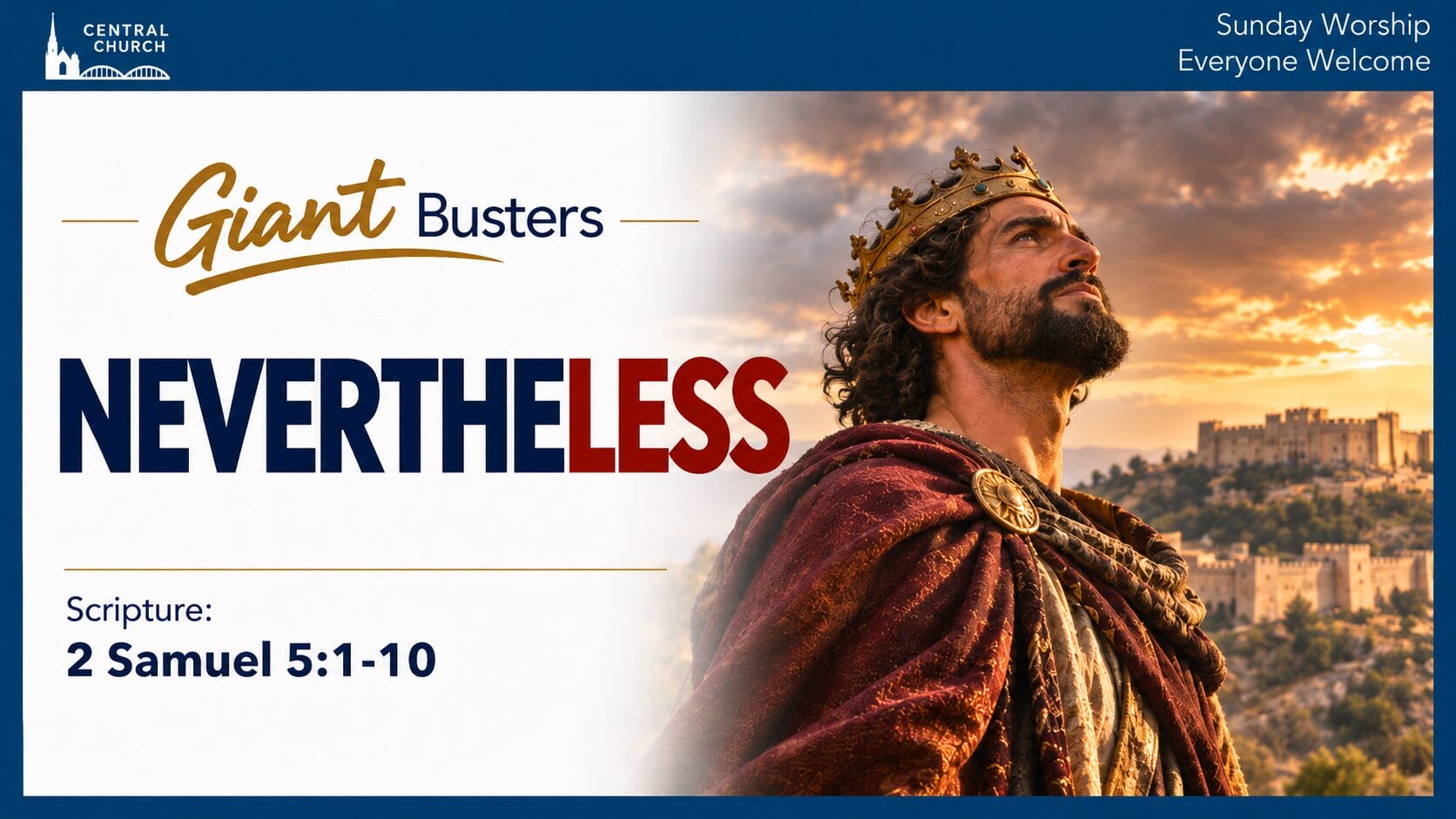
2 Samuel 5:1-10
David Becomes King Over Israel
5 All the tribes of Israel came to David at Hebron and said, “We are your own flesh and blood. 2 In the past, while Saul was king over us, you were the one who led Israel on their military campaigns. And the Lord said to you, ‘You will shepherd my people Israel, and you will become their ruler.’”
3 When all the elders of Israel had come to King David at Hebron, the king made a covenant with them at Hebron before the Lord, and they anointed David king over Israel.
4 David was thirty years old when he became king, and he reigned forty years. 5 In Hebron he reigned over Judah seven years and six months, and in Jerusalem he reigned over all Israel and Judah thirty-three years.
David Conquers Jerusalem
6 The king and his men marched to Jerusalem to attack the Jebusites, who lived there. The Jebusites said to David, “You will not get in here; even the blind and the lame can ward you off.” They thought, “David cannot get in here.” 7 Nevertheless, David captured the fortress of Zion—which is the City of David.
8 On that day David had said, “Anyone who conquers the Jebusites will have to use the water shaft to reach those ‘lame and blind’ who are David’s enemies.[a]” That is why they say, “The ‘blind and lame’ will not enter the palace.”
9 David then took up residence in the fortress and called it the City of David. He built up the area around it, from the terraces[b] inward. 10 And he became more and more powerful, because the Lord God Almighty was with him.
Transcript
(Transcribed by TurboScribe)
Can we just say thank you to the people of this place? You know, this is just... Carl doesn't know what he's coming to. He just doesn't know what he's coming to. He is one of the most blessed people in the whole wide world to be able to come to this church, because it's just a place that works and shows how Christ wants us to work.
I walk in, I said, Alexander, we just need to talk about... He says, relax. Taken care of. And it's just done.
It's all taken care of. Gary took care of asking Gerald to play for this morning. Got the choir going.
Alexander had everything ready. Sound guys had the stuff ready for George and for Alice. Praise team comes up.
They're just there. They play. Catherine is on the organ this week.
I sent her a text and said, when we do the offering, will you play a Mighty Fortress in the text? Sure, why not? That's amazing. I prayed it. We expect there's going to be something going up there.
But if Ted and Grace don't do that, it's not going to be there. If Greg and Adolph don't take care of the live stream, there's no live stream going on. If Paul doesn't come down and say, turn on your back.
You're not on yet. There's no sound that's going to be there. They stand at the door and they greet and they say, good morning.
That's what Paul wrote about when he says, the church is like a body. It doesn't just have a head. It has everything else.
You also find those that you put clothes around because if you call them by their name, it might be rude, but they too are welcome in the church, said Paul. And Central, that's who you are. Can you just give yourself a hand? I didn't prepare a sermon.
That was the sermon. Amen. Go home.
Go home. Lord, in these moments as we open our hearts to allow your word through your Holy Spirit to come into our lives, help us, Lord, to go and live this word. For it is more than words.
When we speak these words, your Holy Spirit translates them into our lives and puts them into action into our lives. So again, this morning, as we quiet ourselves before you, all we ask is that we want to see Jesus and only Jesus. Amen.
Can I start by reading this morning and then we'll stop halfway through and I'll do a little bit and then we'll continue there. This is the last in our series on giant busters today. So next week we'll start a new little series, a two-part series before we get into Advent.
All kinds of lasts for me, my last Remembrance Day service with you. Next week we'll have my last time that I'm going to ordain elders. And so and so it goes, all the lasts coming up.
2 Samuel chapter 5. I'm going to read verse 1 to 5 first and then we'll go to 6 to 10 a little later. All the tribes of Israel came to David at Hebron and said, we are your own flesh and blood. In the past while Saul was king over us, you were the one who led Israel on their military campaigns.
And the Lord said to you, you will shepherd my people Israel and you will become their ruler. When all the elders of Israel had come to the king David at Hebron, the king made a covenant with them at Hebron before the Lord and they anointed David king over Israel. David was 30 years old when he became king and he reigned 40 years.
In Hebron he reigned over Judah seven years and six months and in Jerusalem he reigned over all Israel and Judah 33 years. Pete sits on the road and leans his head against the wall but actually he feels like banging his head against the wall because most people misspeak every now and then but he just can't help himself. Every day he just can't keep his mouth shut and he hurts people all over.
And Joe. Joe and his failures. He tried the family business, didn't work out.
Worked for a guy as his manager for a while, then got canned because of stuff that happened and now he's sitting in jail and he's not sure about the future and what the future might hold for him. He feels like kind of his life has just been one flop after the other. So does she.
Her first marriage didn't work out, neither the second and by the third she knew the court clerk's grandchildren by their name. She should have realised it after number four but it only hit home after number five failed that she really wasn't made for marriage. And then then there's us and I ask myself what is that one weakness or bad habit or rotten attitude where satan has a stronghold on me? And there's that word stronghold.
We're going to hear it more than once today. That big old fortress with its high walls and and its impenetrable wooden doors. Stronghold.
It just feels like satan has claimed a stake over that one weakness and he built a rampart all around that and he's just saying you're never going to touch that weakness. He places himself squarely between God's help and my explosive temper or my frail self-image or my secret vice or my addiction that I try to hide or my fill in the blanks. Strongholds.
They're tough things. They're strong exactly as the word says. They don't break and when they get hold of you it's like a vice grip.
They just don't let go. And that's what David faced when he stood before Jerusalem. Now now just for a moment and Ted we have slides for this.
The Jerusalem that David saw is not the Jerusalem that we know that looks like that. That had the first wall, the second wall, the temple is on there, Herod's palace is on there, all of these upper cities, lowers. No it was that little red block.
So just before we go to the next one. And it was surrounded by hell, right? You know that. Jerusalem surrounded by hell.
What is the Hebrew word for hell? Gehenna, right? It's right there. The valley of Hinnom because in Hebrew the word for valley is Ge and the word for Hinnom is Henna. Gehenna, the valley of Hinnom.
Why? The fire never stopped. The crying never stopped. The bones were lying there and the worm never stopped because what happened in the valley of Hinnom was pagans had their altars there and day and night they sacrificed the children, their firstborn children to their pagan gods.
And as they sacrificed the fires were going up day and night mothers were crying about their children. The bones would lie there of those kids that were sacrificed and the worms would eat the bones. And when they looked at the valley they said that's hell.
Gehenna. Just sorry I was off on a tangent. The Jerusalem that David saw is not the same Jerusalem as we see was that little red one.
So Ted go to that next slide. You got it? There we go. This is the Jerusalem that David would have seen.
Just that small little piece there with the Gihon Springs there. And note the Gihon Springs because they're kind of important for the story. Kidron Valley and then of course the valley of Hinnom on the other side.
That was it. For now we can leave it like that Ted. So when David looks at Jerusalem he sees this stronghold, this fortress.
But it's not just the walls and the soldiers. It's what's inside that was so scary. The Jebusites.
The Philistines fought against the Amalekites. The Amalekites fought against the Hebrews but no one messed with the Jebusites. Except for David that is.
David we just read was king over Judah down in Hebron. And then he became king over all of Israel but it was still this divided kingdom. The ten tribes in the north.
The two tribes in the south. And by now David had a headquarters in the place called Hebron. And so Ted let's go to that next slide.
So Hebron is down south in Judah. But he's now king over Judah and Israel. Needed a place that was neutral and a place that was closer to both of them.
And Jerusalem fit that perfectly. So now let's go to verse 6. Nevertheless David captured the stronghold of Zion which is the city of David. On that day David had said anyone who conquers the Jebusites will have to use the water shaft.
Remember I said check that spring there. We'll have to use the water shaft to reach those lame and blind who are David's enemies. That's why and I can add a word in there.
That's why today they say the blind and the lame will not enter the palace. David then took up residence in the stronghold and called it the city of David. He built up the area around it from the terraces inward and he became more and more powerful because the Lord God Almighty Yahweh Elohei Tzebo'ot was with him.
The Lord of heaven's armies. The Lord to whom nothing is impossible. The Lord who is always the same.
Did you hear the word stronghold twice in that little passage we read? Jerusalem fit that perfectly. Those high walls, those big gates, those ramparts. It also fit someone gave the stronghold this this definition of this old, scary, discouraging, difficult challenge.
And that's exactly what Jerusalem was. This old, difficult, discouraging fortress. Difficult because when they looked up there were the walls.
There were the soldiers standing on the ramparts ready to shoot the men as they tried to climb the walls or pour the hot oil out of them or dump the the rocks on them. There were those doors that no one could touch. But also discouraging, right? Verse six, the Jebusites said to David, you will never get in here.
Even the blind and the lame will ward you off. They poured this mockery on David and his men. But here's the thing, just as the Jebusites poured their mockery on David and his men, Satan to this day pours his discouragement onto us when we face those strongholds.
And it's like, Peter, you're never going to do that. You're not going to make it. Sorry for you, Alexander.
You thought the Lord's going to be with you. It's not going to. That's what he does daily to us.
Just pours this discouragement over and over and over trying to break us down. So here's the thing. If you've experienced this and this discouragement in your own life, maybe your story needs the one word that was there in David's story that sometimes we just fly over.
Did you notice the word? Nevertheless. The walls were high, soldiers were ready, the doors were closed. Nevertheless, David conquered, captured the stronghold of Jerusalem.
We all need a nevertheless every now and then. Here's the good news. God has plenty of those to go around for all of us.
Here's the second part of the good news. Strongholds don't mean a thing to God because you see, here's our problem. We try and attack the strongholds with our little toothpicks.
God comes with his big old, what's the word? Ah, you got it, battering ram and his cannons and those walls just crumble and those doors just break down and he opens strongholds that we thought were closed. That's what he did for David and he'll do the same for us if we do what David did. What did he do? David turned a deaf ear to all of that discouragement, to all of that mockery and David focused on the Lord God Almighty and when David did that, that stronghold never held.
It also didn't hold when Nehemiah stood on those walls not many years after David and he stood on that same thing. It also worked for Jesus when Satan mocked him and he gave him three concise sentences and three scriptures. See, Jesus and Nehemiah and David all practised the same thing, selective hearing.
They chose not to hear the mockers and they chose to listen to the real voice and we have that choice. You can decide because there's always those two voices that come with us, right? The one says you can do it, the other one says you can never do it. The one says you're strong, the other one says you're the weakest weakling that I've ever seen.
The one says God's strength is in you, the other one says you just failed again. The one builds you up, the other one breaks you down. The choice is yours.
Which voice do you want to listen to? And my question is, why would you want to listen to the voice of the mockers when you can listen to the voice of Yahweh Elohim, the Lord God Almighty? David chose to listen and because of that, David had a different perspective. Where everyone else saw walls, David saw a tunnel. And because David did that and did the unexpected, he achieved what no one ever thought was possible and we can do that.
If only, if only we choose to do what David did. Here's the thing, who knows you're only one prayer away from your nevertheless because God gladly gives them, graciously. He did for Pete, right? Remember Pete who always put his foot in his mouth? God released Satan's hold on Pete's tongue and if you want proof of that, go read his sermon in Acts chapter 2 on the day of Pentecost.
Impetuous Pete became Peter, the apostle. He did that for Joe who failed at the family business and failed with a manager and no one thought he would amount to anything and yet Joseph became the prime minister of Egypt. He did that for a woman who was abused and hurt five times in marriage and yet she became the one who led a whole Samaritan village to meet their saviour.
Peter put his foot in his mouth, Joseph was in jail, Samaritan woman's marriage has failed and Jesus was dead in a grave. Nevertheless, Peter preached, Joseph ruled, the Samaritan woman brought people to Jesus and Jesus rose from the dead and you fill in the blank because your nevertheless awaits you and we just bust all the giants in six weeks. Amen.
Take a few moments of silent prayer.
Oh Lord, in our own strength we see the walls and ramparts and the gates and we're scared but when we stand on the Lord God Almighty, we find that nevertheless. Thank you.
In Jesus name. Amen.