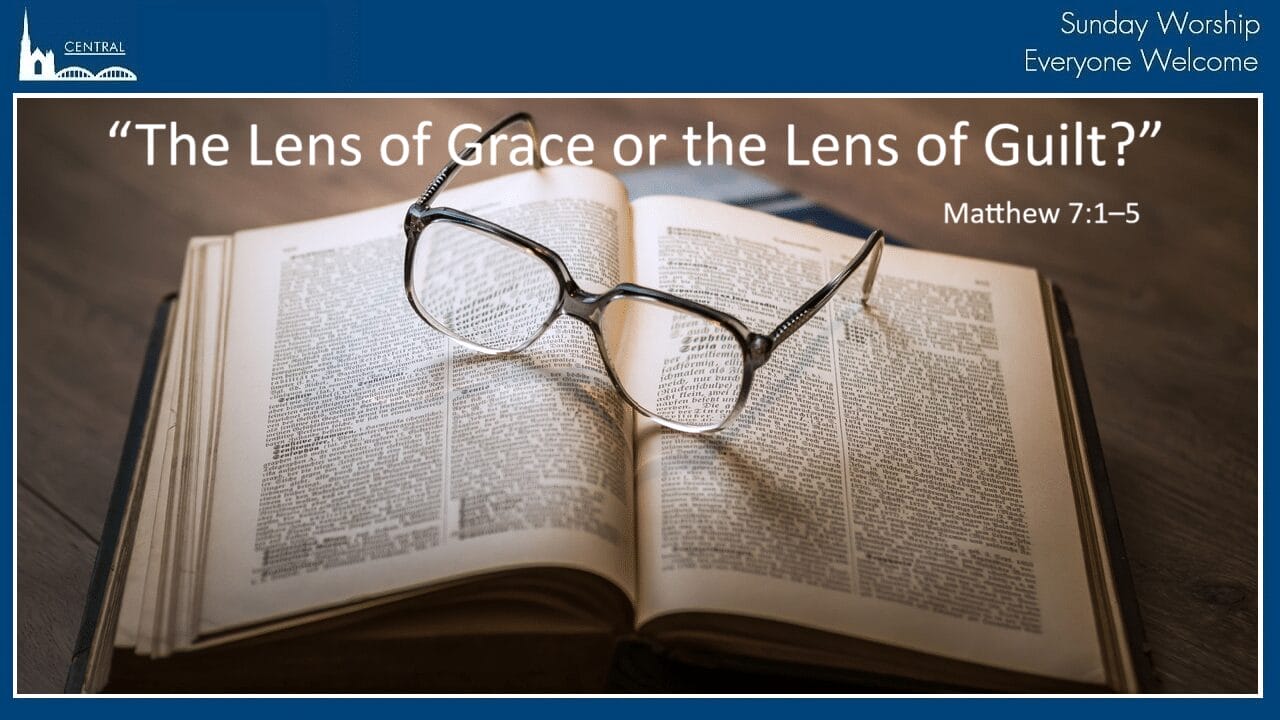
Matthew 7:1-5
Judging Others
7 “Do not judge, or you too will be judged. 2 For in the same way you judge others, you will be judged, and with the measure you use, it will be measured to you.
3 “Why do you look at the speck of sawdust in your brother’s eye and pay no attention to the plank in your own eye? 4 How can you say to your brother, ‘Let me take the speck out of your eye,’ when all the time there is a plank in your own eye? 5 You hypocrite, first take the plank out of your own eye, and then you will see clearly to remove the speck from your brother’s eye.
Transcript
(Transcribed by TurboScribe.)
Thanks Alexander. We were talking at the back, he's like, I'm running out of ways to introduce you. I said, well then just say, here's Jim.
That works. I'm glad you used my last name. That's always, that's always fun too.
Yeah, so I was read the Riot Act. I was greeted by two armed guards at the door when I came in, reading me the Riot Act. We have no internet, so it's got to be recorded.
Stay in the box. So I thought, okay, I'll sit on my stool and I'll behave myself. No, the truth is, I think I've told this story before, but when I turned 60, I had this brilliant idea that I would run a marathon.
So I started at 59, I started to train. I probably ran about a thousand kilometres to train. Now when I say I ran, I probably walked the first few hundred just to get my body going again.
But I ran a marathon when I was 60. I turned 65 a month ago and I just had my two granddaughters, ages five and three, come and visit me for one week. The marathon was easy compared to ranging out with my granddaughters for a week.
So my typical joke is that whenever I see somebody in an audience start to doze off, I try to increase my energy and raise my voice and just be a little bit more theatrical. And just so that nobody sleeps on my watch. This morning, my promise is that I won't have a nap.
I'll wait till I go home to have my nap. It's been an exhausting, exhausting week, but so much fun. How many get to hang out with grandchildren and little ones? I mean, it's so much fun.
There's so many things I've learned from them. There's things I didn't know I didn't know until I had a three and five-year-old hang around and tell me that I didn't know what I didn't know. And it's been a lot of fun.
You know, I was thinking, you know, when we're talking about, you know, the internet down, it's amazing when you think back of, you know, we're going to be diving into, you know, around the Sermon of the Mount, right? So there thousands of people gathered around Jesus. No internet, no PA systems. How did they project out to that many people without the technology that we have today? It's absolutely amazing when you think about it.
And this morning, before we get started, I wanted to encourage us as we come in to allow our imaginations to think about those things. You know, some of the songs that we sing, we sing the words, but do we really see the depth of the words? Do we see the pictures that the music writers are trying to create? You know, what David read it out of Revelation, you know, just picture what that is. And so much of interpretation understanding, I think, involves our imagination.
Would you agree? We need to bring our imagination. And that is one of the key things I think I've learned this past week with a three and five-year-old. Their imagination is endless.
It's just so amazing what they can come up with and the stories that they can create on the fly, you know. And we somehow, as we grow older, we become more rigid. We become more compartmentalised.
We begin to think, oh, I've got it all figured out. I know it, been there, done that, right? And we don't use our imaginations quite as much. So I want to encourage us to open up our imaginations and use our imaginations to allow God to paint pictures in our minds as we sing songs, as we listen to scripture, because it's important to engage those senses.
Would you agree? So I want to encourage us to do that. And, you know, I was thinking, again, with internet down, I was thinking of all the times we travel into Central America. I, as Alexander said, I was a youth pastor.
And part of that was we led short-term mission teams down through the summertime. And why you go into a hot place in the middle of August, I have no clue, but that's the way it worked out for us. And so we would go and we were going, and it was always funny that people down there, the locals would always say, Jim, why do you Canadians always talk about the weather? Every missionary that comes down from Canada and North America talks about the weather.
They said down here, it's either hot or hotter. Like, that's it. Those are the two extremes.
They're hot or hotter. You know, I said, well, if you lived in Canada, you would understand. And so the one day I was able to go shopping with them in one of their major supermarkets, and it went through the freezer section.
And I said to the missionary, I said, see that leg of lamb in the freezer? He says, yeah. I said, in Canada in the wintertime, if you stayed outside and exposed your leg, your leg would look like that leg of lamb. And he goes, oh.
So he got it. But one of the times we were down there, the power went out. So we're at this church, and it was a building that was built in between other buildings.
So there's solid walls on either side. There's a solid wall at the back, and there's just a gate at the front to let people in. Because of, you know, thieves breaking in and doing all that wonderful stuff, they didn't really want a lot of windows.
So it was a fairly dark place. So they had the lights going, they had the intercom going, and I was speaking to a crowd. And all of a sudden, a storm brewed up, and it took out the power.
And not only did it take out the power, it took out my microphone, it took out the lights. So now we're in pitch black. And I said, what do I do? And I thought the same thought that I just shared with you.
Jesus gathered with thousands of people. Paul hung out with hundreds and hundreds of people and didn't have a sound system, didn't have everything. So I just projected my voice, and I continued to preach and teach in darkness with no microphone, and it was so much fun.
So I wasn't threatened when I was met by our three, our two armed guards that told me there was no internet. That's all good. We still got the microphone, and you know, that's the beauty of these kind of designs.
You know, they're designed to allow the sound to project. So over the next few weeks, I want to dive into Matthew. We're going to hang out around Matthew 7. So in Matthew 7, it's, you know, from 5 to 6 and 7, it's all around the Sermon on the Mount, right? That's this big section that Jesus, there's more red letters in this section of the Bible than any other section of the Bible.
He was just going through everything. We had the Beatitudes. You probably heard about those in chapter 5. And He went through a whole bunch of teaching on, you know, how to serve others and look after others and care for others and being the salt and the light.
He went through a whole gamut of teaching. And in verse 7, He starts to talk about judgement. And I thought that would be a fun thing.
I mean, wouldn't that be a great topic to talk about, judgement? Any takers on that Not so much. But I thought it would be a fun place to hang out and just talk about that. So I want to start with just reading our text today.
And it's in Matthew 7, 1 to 5. And then it says this, it says, Jesus says, Do not judge, or you too will be judged. For in the same way you judge others, you will be judged. And with the measure you use, it will be measured to you.
Why do you look at the speck of Sardis in your brother's eye and pay no attention to the plank in your own eye? How can you say to your brother, let me take the speck out of your eye, when all the time there is a plank in your own eye? You hypocrite. First, take the plank out of your own eye, and then you will see clearly to remove the speck from your brother's eye. So it's interesting when we think about that.
I've got a toothpick here. Now, from where you're sitting, you probably can't see that. And on the recording, you're definitely not going to be able to see that, right? It's just a small, little, little, little thing.
But as I pull it up to my eye, right, it obstructs my vision. And that's, in a sense, what Jesus is talking about here. We're so focused on what we see in other people, that we forget when it's pulled up so close to us.
Like if I use my pen and close one eye, I lose most of you. And what I want to challenge us with this morning is the lens in which we look at people. The lens that we look at people is often affected by many different biases that we get as we grow up, right? We have family or school biases.
We're taught certain things. We're taught to look through certain lenses. And so we take those lenses, and that's how we begin to view the world, right? When we learn a concept, we learn an idea, we learn a thought, we learn that we're not supposed to associate with a certain people group or to be around a certain thing.
That's the lens that we begin to look at things through, right? When we look at scripture, how many times was it, you know, talked about the Samaritans, right? Stay away from those Samaritans. Don't have anything to do with those Samaritans, right? They were painted with this lens in which not to look at. So they viewed everything through that lens.
There's the biases that we learn from our families and our friends, right? So the people we hang out with, you know, I talked to my granddaughters making up stories. Well, you know, sometimes our friends can make up stories, and we start to believe those stories. And even as we transition through relationships, through friendships, right? We can take those lenses of experience into new relationships.
So if we had an experience in a relationship, you know, if you've ever experienced puppy love or a first love and all that stuff, and it doesn't work out, and we're heartbroken, but we take those experiences, those biases, we take those into our next relationship. And that's the lens in which we look at the new relationship. We line it up and say, okay, does it fit this? Does it fit that? Does it fit this? I hear this experience.
I hear this tone. I hear this language. And we begin to look at those things through that bias.
So there's many different ways that we can pick up biases, and we don't even recognise until we get confronted with a scripture like this, talking about judgement. Because that's really what it is. It's saying, okay, I've got it figured out.
I know who I am. I know who I serve. I know what is right.
I know what is wrong. I've got it all figured out. Again, my granddaughter, sometimes you can help them with things.
Other times it's like, I've got this. Leave me alone. I got it all figured out, right? How many are like that? I mean, we get like that, don't we? Where it's like, okay, I've got this figured out.
But then we begin to look at people through that lens and expect them to fit that lens in which we're looking at them. How many of us, you know, today when we go into supermarkets, right, you notice there's more and more people standing at the entrances and the exits with a cup or with something looking for handout. How many of us judge as we walk up to that person? How many of us judge as we pull up to a traffic light going, oh no, here's another one, right? We judge people.
How many of us judge people as we walk into a room, right? We're looking around. We're scanning the room. We're beginning to judge people.
We're using our biases, our lenses to project that onto other people. And what Jesus is saying is don't look so much out to them. Let's consider what's in your eye.
Let's consider the lenses that you have, that you're looking through. Remember, I used to work with this older guy and he wore glasses and he was a real character. And every once in a while, he would just stand.
He'd be looking around confused. He would take off his glasses, rub his eye, put his glasses back on, look around really confused, take his glasses back off. He'd rub the other eye and he'd put them back on.
And then he would take his glasses off and he would clean the lens and he'd put it back on and smile and walk away. He always did that. It was so funny to watch him.
But the truth is that sometimes we look at the lens. We don't imagine it's something in here. It's just the lens that we're looking through.
It's the way we're viewing things that we need to look at and just clean up and adjust. There's an American psychologist. Haslov is his name.
Haslov. And he created what he calls the Haslov hierarchy. And in it, he said there's five basic steps that humans go through.
There's five basic needs that we go through. And it starts with just the basic needs of just food, shelter and water, right? It's all humans need that. Then it goes up further into we need security, need security in financial security, health security, all that kind of stuff.
So that's the next level that we look at. The third level is relationship security. We look at relationships and we want to build strong relationships and strong connections so we feel secure in that.
And then it grows up to our self-confidence, our self-esteem, our self-worth, our values and so on. We begin to look and formulate those. And then the highest is what they call self-actualisation.
I know that sounds like a real woo-woo term, but it's really basically just saying that's the point where you really focus on becoming your very best. Becoming the best version of you. Once you've got these other needs satisfied, then you can focus on that.
Now it's accepted by some groups of people. Other groups of people really find it controversy. Here's the deal when it lines up to scripture.
Jesus came and flipped everything upside down, didn't he? He flipped everything upside down. The Jewish people were looking for rulers. He was looking for the new king.
So they're scanning the horizon, looking for someone that would qualify to be their new king. Somewhat like what we do when it comes to election time, right? Election comes around, we're looking for the cream of the crop. We're looking for those leaders that rise above that we can say, yes, I'll cast my vote on that person, right? And that's what the religious leaders, that's what the leaders were doing at that time.
They were looking for someone that they could appoint as a king. That's what they were looking. But what did Jesus do? Or what did God do? God flipped it upside down and he came as a baby, completely unaware of what was going on.
He completely flipped the script. And Jesus did that through his entire ministry, right? Where he physically even did it, where he went into the temple. You remember the story of going into the temple where he got angry at the merchants in there selling and trading and buying and doing all the different things that they were doing.
And he flipped the tables. And what did he say? He said, you know, he said, tear down this temple and in three days I'll rebuild it. He was foreshadowing what was to come.
He was foreshadowing what he was doing. But what he did was he flipped everything upside down. And rather than taking Haslo's idea of working up the progression, what does it tell us? In Matthew 6, 33, it says, seek first the kingdom of God and everything else will be added unto you.
He tells us over and over again. He says, look it, I know you need to eat. Don't worry.
Ed, I'll make sure you get that hamburger at lunchtime. Right? I know you need to have a place to sleep. John, I'll make sure you got a comfortable bed tonight.
So he knows that we need all those things, but he's saying, seek first me and then everything else will be added unto you. So he's flipping the script of most psychologists saying that we need these basic needs, net, food and shelter, security, comfort of friends and family, growing in self-esteem, growing in self-confidence. But Jesus says, no, get up here first and you can become this before you need to worry about any of these other things.
I have a good friend. He challenged me with the way I give. He doesn't earn money and give off of the money.
He decides at the beginning of the year how much he wants to give. And then he goes to work to earn that much money to give. Isn't that interesting? As a Christian, as believers, that's a real challenging thought to think, OK, God, how much do I want to give this year? How much are you laying on my heart to give? And then backtrack and say, OK, if I tie 10 percent or 15 percent or 20 percent or whatever it is that he lays on your heart, then you go to work and say, OK, then I need to earn this much income and then we go to work.
He flipped the script on his giving. His whole attitude and approach to giving just shifted around. Rather than taking what the world gives us first, trading our time for dollars, he decided, you know what, I'm going to seek God first and say this is how much I feel God is calling me to give.
This is what I need to make. And then he builds his business and he goes out and does it. And Jesus did this all the way through, just flipping the script.
But we have gotten in a position of just judging, of just looking at things. And really when we're judging, we're saying I've got this figured out. I know what's right.
Right. Because that's the that's the that's the whole responsibility of a judge in a court, listening to the evidence and making a rule. Well, you and I are no different when we look at other people and judge them on their appearance, judge them on their social status, judge them on their position at the grocery stores or whether they're inside buying groceries or outside begging for food.
We judge them based on what we see on the outside. But what Jesus is really telling us to do is flip the script. Rather than judge, because when you judge that same measure of judgement that you use is going to be used against you.
And so now we become no better than anybody else in history that has cast judgement on others. I was watching a Netflix show and it was based on the early 1900s, like late 1800s, early 1900s, where a lot of industrial revolution, a lot of change was happening. Right.
Automobiles were coming on the scene. Electricity was now coming into homes, running water. You know, all those things were beginning to come in home.
And there was just this conflict between, you know, all the new technologies and people embracing and not wanting to embrace it. But there was also in the midst of this was a heavy revolution of people coming over from across seas to indoctrinate local people. I won't get too specific, but they're just focussing on particular people groups and just making them believe what they believe was right.
And it was ruthless, some of the things that they did, the measures that they went to convert these people to believe their Christian doctrine, believe what they believe is right. They were casting judgement on these people because of the way they acted, because of the way they raised their families, because of the things that they believed. They cast their judgement on them and tried to literally just physically beat it out of them.
And inside I was getting very angry, you know, as a believer, watching how these so-called believers were imputing this, were enforcing this as a law that you must obey this way, you must do things this way, and so on. I was getting so angry at it. And I really had to look at it and say, what is the connection of that? And I realised it was, it was just, I was, part of me was angry because it was connected to the church and how we were ruthlessly just doing things over the years.
But then I got thinking about my attitude, the speck in my own eye, or the log in my own eye, rather than the speck in their eye. And then I thought, how, how judgemental am I towards other people groups or other people in geographical or economical situations? How judgemental am I? And then I suddenly realised that that judgement that I was casting on made me no better than them. Do you get the similarity? Right? I was tied to them because I'm judging, not as ruthlessly, but I'm still judging.
You know, it's like sin. When they talk about sin in the Bible, there's no good sin and bad sin. It's just sin.
There's no degree and levels of sin. It's just sin. And so with judgement, it's the same thing.
It's when we judge, we're put into that same category as anybody else that has ruthlessly imparted something and judged other people. So I really believe that what Jesus is saying is you need to have a look at yourself first. Before you start casting stones, before you start casting judgement, before you start casting your projection, your biases, have a look at what's in your eye, what's in our life before we step out and do that.
And I really believe that that's why he's saying, you know what? Seek first the kingdom of God, because there's no way you can work your way up through it like Maslow's hierarchy. You can't just obtain this and get this and feel comfortable and go to the next level, next level. Jesus is saying, no, I'm giving you access to get up there right now.
Begin to seek me first. Become the person that I've called you to be. Step out of that judgement.
Step out of those different things and become that person. Wouldn't it be amazing if when we looked at people, we could look at them through God's lens? How many would like that? Changing the lens that we have, you know, tinted, blurred, like my friend rubbing his eye, you know, a little bit, a little bit, a little bit dusty, a little bit dirty, a little bit smudged with fingerprints. Wouldn't it be amazing if we could take those, those biases, take those lenses off and begin to see things through God's eyes? Because that's really what Jesus is calling us to.
He's calling us to look, not through our own judgments, not through our own biases, but looking through his eye. When we seek the kingdom, anything is possible. You know, I was thinking when, when Alexander was praying for your husband this morning, Elizabeth, you know, when we seek him without bias, anything is possible.
Healing is possible. You know, it's, some scholars believe that this whole section of the, through the Beatitudes and this whole section through Matthew on the Sermon on the Mount is something that is to yet come. They believe it's a future tense.
It's like not in this lifetime, but in the next lifetime we'll be able to, we'll see these different things. I really believe that what Jesus says we can, we can do, we can do. Like, I take him at his word.
How many else, anybody else take him at his word? I mean, I take him at his word. And if he says to, to seek first the kingdom of God and everything else will be added up to, added unto you. If he says, don't judge because the judgement that you could throw on someone else is going to be used against you.
I take him at his word. And I really believe that the whole part of, of the seeing the kingdom come is just seeing it flipped upside down and just say, okay, let's step into this first. It's kind of like, you know, like if we take Haslov's hierarchy, it's like a pyramid.
If we flip that upside down, put the pyramid on it, on the tip, and we just step into that first realm and say, okay, let's see God first. Let me look through his, his lens. Let me get my eyes adjusted to the way he sees things.
Because if we begin to do that, then there's less judgement, isn't it? There's less criticism. There's less of so much more when we seek him first. So how can we do this? Good question.
I want to give us a couple of things to, to encourage us this week, because I'm not one to just give you a nice little talk and rah, rah, rah, make you feel good and go home. I mean, that's part of it. I want you to feel good and go home, but I want you to go home with a sense of, of, I need to do something about this.
I don't want to just deliver something and have you go away and go, well, that was nice. Right? And 10 minutes later, somebody asks you, what did he talk about? You go, I don't know. It was nice though, but it was really good.
I don't know what he talked about, but it was nice. So I want to give you some practical things that you can do through the week. The first thing is I want you to ask yourself, what lens have I been using to view others and myself? And that'll be challenging because one of the most influential stories that you'll ever hear is the one you tell yourself, the one that you say about yourself, the way you look at yourself in the mirror, the way you look at your own self-esteem and your self-confidence.
That story will influence you more than any other story. So if we start there and just say, what have I been using to view others? And what have I been using to view myself? And as we begin to think about that every day, it'll begin to bring some of the scripts. It'll begin to bring some of the stories.
It'll begin to bring some of the dialogue. And some of you right now, as I'm telling, I'm saying this, you're, you're thinking of some of the dialogues. You're thinking of some of the scripts, right? Because we tell ourselves, well, I can't do that because I'm, I'm old.
I can't get that place because I'm a woman. I can't do this because I've got a bad knee. I can't do this.
And we begin to rehearse scripts. And so often we begin to believe those scripts over what scripture has to say. So what I'm suggesting is let's flip those scripts and let's see what God has to say about those stories.
Because that would be, the next thing is, where do I need to remove the plank before I speak into someone else's lives? What do I need to go to work on in me before I can ever start pointing fingers? You know, I remember when I first got married, I, you know, the first few years are always wonderful, right? Marriage is wonderful in the first few moments, months, weeks. And then as the years go on, sometimes it gets a little bit challenging. Now, I know you may not be like me.
You may have had a perfect marriage all the way through your entire life. God bless you. But for me, there were some real struggles.
And it was around 10 or 12 years into our marriage, I really started to really feel the struggle. I'm thinking, well, if my wife was just a better wife, if my, you know, she was just a better mother, she was just a better, and the list went on and finally God got a hold of my attention. He said, do you see that finger you're pointing? I said, yes.
You see how many fingers are pointing back to you? And I go, uh-huh. He says, don't you think you need to go work on that first? And that was the shift in my marriage. I didn't need my wife to become a better wife.
I needed to become a better partner. And so I needed to go to work on me. And so what I want to encourage us is, rather than being the holier-than-thou Christian walking through the city squares and walking through our offices and our workplaces and our community centres and everywhere else, look at the things that we can adjust.
Just have an honest look. I'm not saying go search for demons under every rock, but just have an honest look and say, are there particular ways that I've been looking and judging and wanting to remove planks from other people's lives that I haven't even seen the one in my own eye? And the next thing to think about is, how would my relationship change if I viewed others through a lens of grace? Oh man, that's a toughie. What would life look like if I treated others, if I treated my relationships with a super extra scoop of grace? How many like an extra scoop of ice cream through this hot weather? All right, come on, be honest.
I see one honest hand way in the back, and I see another one coming up over there. Right, we all want that second scoop of ice cream on a hot, hot day. What about becoming a person that gives that extra scoop of grace, whether it's hot, whether it's cold, whether you're infuriated, whether you're whatever it is that comes up.
What if we were able to put an extra scoop of grace on that instead of adding more fire to the flame that's erupting, right? What would that look like? And that can only come when we seek God first. We can't be, you know, expecting to be full of grace and mercy and love and