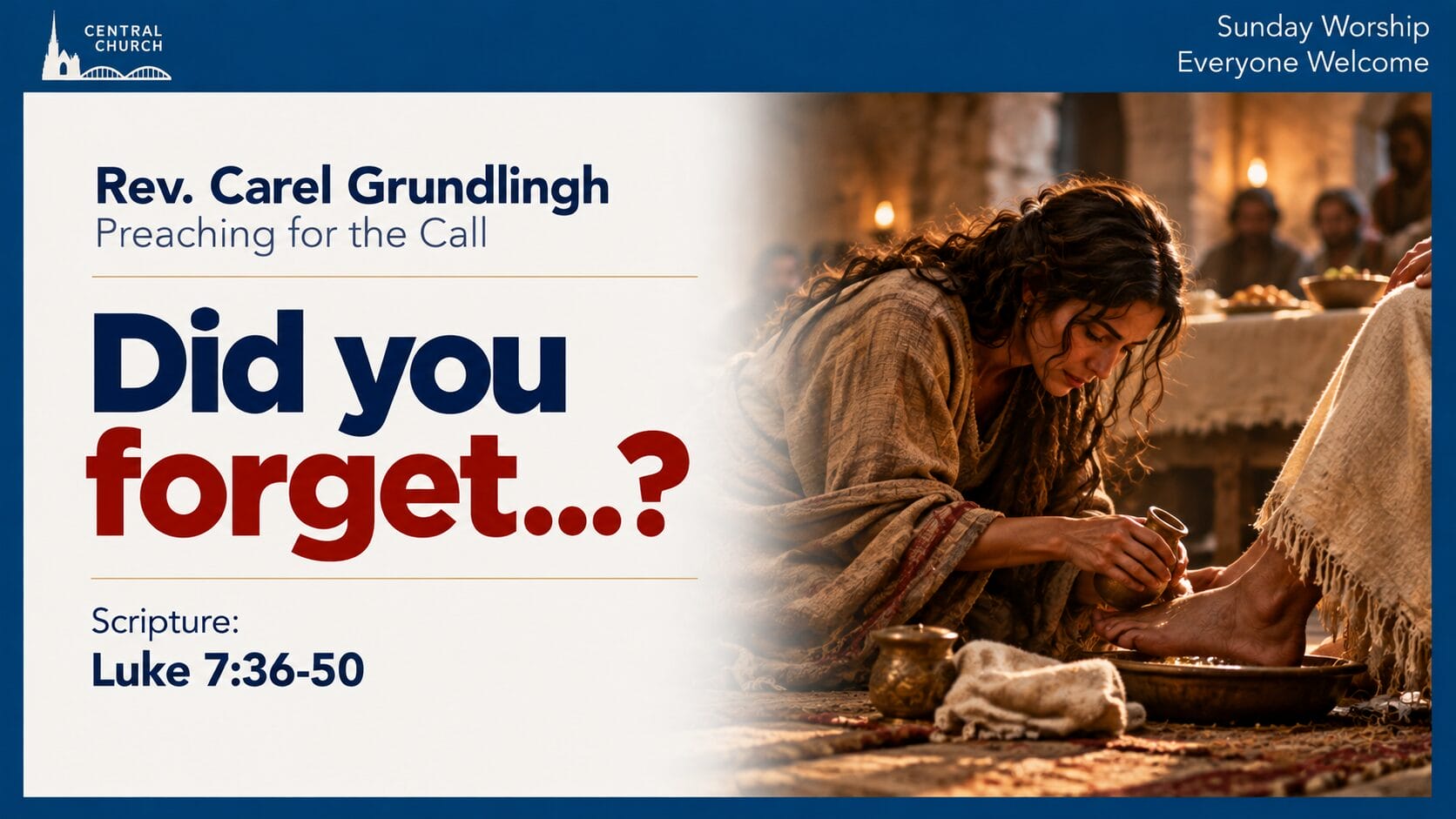
Luke 7:36-50
Jesus Anointed by a Sinful Woman
36 When one of the Pharisees invited Jesus to have dinner with him, he went to the Pharisee’s house and reclined at the table. 37 A woman in that town who lived a sinful life learned that Jesus was eating at the Pharisee’s house, so she came there with an alabaster jar of perfume. 38 As she stood behind him at his feet weeping, she began to wet his feet with her tears. Then she wiped them with her hair, kissed them and poured perfume on them.
39 When the Pharisee who had invited him saw this, he said to himself, “If this man were a prophet, he would know who is touching him and what kind of woman she is—that she is a sinner.”
40 Jesus answered him, “Simon, I have something to tell you.”
“Tell me, teacher,” he said.
41 “Two people owed money to a certain moneylender. One owed him five hundred denarii,[c] and the other fifty. 42 Neither of them had the money to pay him back, so he forgave the debts of both. Now which of them will love him more?”
43 Simon replied, “I suppose the one who had the bigger debt forgiven.”
“You have judged correctly,” Jesus said.
44 Then he turned toward the woman and said to Simon, “Do you see this woman? I came into your house. You did not give me any water for my feet, but she wet my feet with her tears and wiped them with her hair. 45 You did not give me a kiss, but this woman, from the time I entered, has not stopped kissing my feet. 46 You did not put oil on my head, but she has poured perfume on my feet. 47 Therefore, I tell you, her many sins have been forgiven—as her great love has shown. But whoever has been forgiven little loves little.”
48 Then Jesus said to her, “Your sins are forgiven.”
49 The other guests began to say among themselves, “Who is this who even forgives sins?”
50 Jesus said to the woman, “Your faith has saved you; go in peace.”
Transcript
(Transcribed by TurboScribe)
Well, good morning to you on this beautiful fall day. It just doesn't get better than this. Beautiful colours, beautiful weather, and we've had it for a week, and I think you've had the same.
Normally, you get about two glorious days, then the wind starts getting blowing. Like, it has been an awesome week. And I am just 10 days shy of saying that it was exactly 10 years to the day since I first set foot here in Central.
It was on November 6, 2016. You were just finishing up building this stage. You still had the danger tape around it, and it was your Remembrance Day service.
You see, I came to meet the folks of the Committee on Education and Reception to do the transfer between the Dutch Reformed Church in South Africa to the PCC. So, I was meeting them up at Winford Drive in Toronto, and through the process, I reached out to Aubrey. So, I phoned somebody, my old youth minister.
He was a minister in Vancouver, and he said, speak to Aubrey. He came more recently than what he did. He can tell you what the change was like, moving from the Dutch Reformed to the Presbyterian Church.
So, I phoned Aubrey just to find out a few things, and he was on the Committee on Education and Reception before. So, Gerard said, phone him. So, I phoned him, and he said, Aubrey said, when you are here, drop in for a visit.
So, I met with the folks on the Friday, and I came down on the Saturday, and both Aubrey and Elsie were so hospitable. I stayed with them on the Saturday evening. Aubrey brought me down to show me his church on the Saturday afternoon, and he was pretty proud about the stage and almost being done.
Like, we spent most of the time, I think it was around there somewhere, just telling me about the stage. And then Elsie and Ellery took me for breakfast on the Sunday morning, because Aubrey had to be here a little bit earlier, and they were just tremendous hosts to somebody that they've never met face-to-face before. Well, I thought the great hospitality was just a bother thing, but after the way that you have received us yesterday with the meet and greet and this morning, it seems like it's actually a central thing.
So, thank you for your kindness, and thank you for the invitation to worship together this morning. It's truly an honour to be here with you this morning. Now, on that particular Sunday, it was my first time in a congregation of the PCC, my first time in a Presbyterian church anywhere in the world, actually.
And after that service, I told Aubrey something along the lines of, well, I actually like the Presbyterian church. It's nice. And I can't remember exactly what I said, but I can remember his reply vividly, well, we are not your regular Presbyterian church.
And then he gave the Aubrey chuckle. Have you ever heard the Aubrey chuckle? Yeah. But here's the thing, for the life of me, I cannot remember exactly what I told him to get the reply.
I forgot. I also cannot remember if I stayed for lunch on the Sunday. I was actually trying to remember, but I can't remember.
I forgot what I did the Sunday afternoon after being here. But sometimes we just forget. It happens.
And it's okay if we forget minor details, but it becomes a problem when you forget important things that happened. In our Scripture reading today, we will see how someone forgot something really important about Jesus. And for that, we will take our Scripture reading from the Gospel of Luke, chapter 7. We're going to do 15 verses, 36 to 50.
And I'm sure that you've probably noticed that even though all four of the Gospels, or all four of them, shares the same good news about the same Jesus, the Messiah, the Son of God, each one of the four has got this unique flavour, this angle, if you wish. Each one presents the same Gospel of the same Jesus with a specific focus. So when it comes to the Gospel of Luke, Luke has got this passion for people, which is probably the reason why he became a medical doctor himself.
And he portrays Jesus as someone who spends a lot of time with sinners, with prostitutes, with tax collectors, with people who are lepers, the unclean, people who have been shunned by their community, that became outsiders. In the Gospel of Luke, Jesus spends a lot of time with outsiders. And John frequently gives us these accounts of Jesus then helping these people.
Another thing about the Gospel of Luke is that the people are always shocked at the company Jesus finds himself in. But Luke wants us to see Jesus' passion to restore people. And this is where we're going to read from today, from Luke, with Jesus doing these kinds of things.
Before we read, let's just quickly pray. Lord Jesus, thank you so much that we do have a Bible, your living Word, that we've got it in a language that we can understand, that we can read at our own time wherever we want. Thank you that it contains life-giving words, that it's essentially your love letter to us.
But sometimes when we do take your Scripture in our hands, we find it oftentimes difficult to understand, and that is because it's meant to be read with the illumination of your Holy Spirit, with your Holy Spirit translating those words into our hearts. So, when we read the Scripture today, we pray that through your Spirit you will speak to our hearts. In Jesus' name.
Amen. So, when one of the Pharisees invited Jesus to have dinner with him, he went to the Pharisee's house and reclined at the table. Now, I need a cushion.
Reclined at a table. They ate dinner in a bit of a weird way in those days. And to understand this story and what happened and how it transpired, it helps to understand the setting.
So, they had this peculiar way of eating dinner. They adopted it from the Roman banquets. So, they would lie on their left side, like pretty much suspended on the left side with their head raised with a cushion at the back.
So, they'll be at the table. The table would be there, and this is how they eat dinner. The table would be there.
The table would either be a mat that has been rolled out, or a little bench with some kind of draping over it. And everything would be there, and they would be leaning that way. The next guest would be on this side, sitting like this, or reclining like this.
And so, they would be around the table. So, you'd almost like sardines, but then you've got the cushion at the back, and that is how they ate these dinners. Reclined at the table.
And the head of the second guest was then close to your chest, and if you were the host, that second guest opposite your chest would be the guest of honour. So, if he wanted to speak to the host in secret, he would lean back upon his chest. So, get that picture in mind.
You want to speak to the host, or the person just to this side of you. You just lean back. You lean your head on their chest, and you could speak to them in secret.
Get something said not for everybody. And that actually sheds light on quite a few passages, other passages in the New Testament. If you remember at the Last Supper in the Gospel of John, Peter was opposite Jesus, reclined on the other side, and Jesus said something.
He said, one of you are going to betray me. And then Peter, being a crush from John, and John was close to Jesus, the disciple whom he loved, he asked John, ask him, who is it? So, then in John 13 verse 25, leaning back against Jesus, leaning back against Jesus, he asked him, who is it, Lord? And there are quite a few of these little things happening in the New Testament, where they would ask him in secret. It's because they ate this way, adopted from the Roman banquets.
Now, another thing about eating this way, the dining area for these affluent people was set up in the courtyard. So, people from the community were actually allowed to gather around and look at these influential people eating and listening to their discussions. So, they could stand around them, like behind their legs, and listen and see what's going on there.
And normally, with dinners like these, important discussions were at the order of the day. Political discussions, business amalgamations, and religious discourse. Naturally, when such a dinner was hosted by a Pharisee, there would most probably be worthwhile religious conversations going on.
And another thing, the homeowner, the host, gets an opportunity to show off a little bit when these people can come in and listen and see how the other half lives. With this setting in mind, let's continue the Scripture reading, as they were reclining at the table. A woman in that town who lived a sinful life learned that Jesus was eating at the Pharisee's house, so she came there with an alabaster jar of perfume.
As she stood behind him at his feet, weeping, she began to wet his feet with her tears. Then she wiped them with her hair, kissed them, and poured perfume on them. When the Pharisee who had invited him saw this, he said to himself, if this man were a prophet, he would know who's touching him and what kind of woman she is.
But she's a sinner. Jesus answered him, Simon, I have something to tell you. Tell me, teacher, he said.
Two people owed money to a certain moneylender. One owed him five hundred denarii, and the other fifty. Now, one denarius was the one day's worth of wages for a manual labourer at the time.
Neither of them had the money to pay him back, so he forgave the debts of both. Now, which of them will love him more? Simon replied, I suppose the one who had the bigger debt forgiven. You have judged correctly, Jesus said.
Then he turned toward the woman and said to Simon, do you see this woman? I came into your house, you didn't give me any word of my feet, but she wet my feet with her tears and wiped them with her hair. You didn't give me a kiss, but this woman, from the time I entered, has not stopped kissing my feet. You didn't put oil on my head, but she has poured perfume on my feet.
Therefore, I tell you, her many sins have been forgiven, as her great love has shown. But whoever has been forgiven little, loves little. Then Jesus said to her, your sins are forgiven.
The other guests began to say among themselves, who is this who even forgives sins? Jesus said to the woman, your faith has saved you. Go in peace. Now, let's quickly explore the three people in this passage.
Let's start off with the Pharisee. We are used to the Bible portraying the Pharisees as enemies of Jesus. They are always in confrontation with him, always looking for opportunities to attack him and to humiliate him.
This is the people who later on had him tortured and killed. And this passage starts off with one of them inviting Jesus for dinner. I mean, what's going on here? And while we are still trying to make sense of this invite from the Pharisee, he goes on and calls Jesus teacher, didaskalos, which is a very respectful title.
So, we've got a Pharisee who is warming up to Jesus. So, somewhere, something must have happened to this Pharisee. This Pharisee named Simon is different from the rest.
This one is a friend of Jesus. Simon is showing interest in this idea of Jesus being the Messiah, the Son of God. Maybe, just maybe, he is even starting to put his trust in Jesus.
The Bible doesn't explicitly tell us whether he's there yet or not. But there's some sort of relationship between the two of them already, as all of this happens at his home. So, there's a close relation between the two of them.
Simon, essentially, is a converting enemy, a Pharisee busy turning into a follower of Jesus. Somewhere, sometime not too long ago, something strange happened to him. The Bible doesn't tell us how or when.
Maybe it was something like Nicodemus, who had some hard questions about being born again. Remember Nicodemus in John 3? The Pharisee that came secretly at night time, he came to Jesus, and then Jesus tells him in 3.16 about how much he loves us. But Nicodemus said in that meeting, he said something, he said there were others like him.
John 3 verse 2, Nicodemus, Rabbi, we know that you are a teacher who has come from God, for no one could perform the signs you are doing if God is not with him. We know. Nicodemus spilled the beans.
There are more of us. Now, if I had to guess, Simon also approached Jesus very cautiously, hesitantly, in secret. But he was so driven to be a friend of Jesus, that he actually didn't care if he would be expelled by the other Pharisees.
He just wanted to know Jesus. And it seemed like it actually paid off, because now Jesus is having dinner with him at his own home. That Simon brings us to the woman.
She was a very infamous woman about town, a morally bankrupt woman, most probably a prostitute. And in Jewish terms, she was considered to be unholy. That would mean that every Jew that she touches will also be unholy for a week.
They were not allowed to go to the temple for a week. They cannot bring a sacrifice for a week. And that is why Simon flipped his lid when she touched Jesus.
Unholy woman touching Jesus, that's a week. Because he's hosting Jesus. His honour is at stake.
And here's this unholy woman. But this woman decided that she cannot carry on like this. She most probably heard all the stories about Jesus spending time with people like her.
Outcasts, lepers, tax collectors, sinners, prostitutes. And then forgiving them, restoring them, changing their lives. And she also wanted that.
Now firstly, a woman of her reputation had no business being anywhere near the house of a Pharisee. But she goes in anyway. To the conversations at the table.
So she goes. And then she did the unthinkable. She touched Jesus.
It happened like this. She was overwhelmed with grief about her past. And that she couldn't help herself.
Maybe the conversation that Jesus had at the table helped this along. So she started sobbing. And standing at his feet.
Remember this thing actually helps us understand this. Shedding her tears. It landed on Jesus' feet.
And she felt all embarrassed about this. And she was trying to find something to wipe it off with. And the only thing she had was her hair.
So she wiped it off with her hair. And now she's touched him. Now she's already touched him.
So she might as well anoint his feet with her expensive perfume. Which is something we carried with him for the trade. Now she can might as well just carry on.
She's extremely brave. Extremely brave. What is bound to happen to her is that she will be dragged out into the street and beaten by the guards.
That's just how it worked. But she does this anyway. She wants Jesus to change her life.
And of course we have as the Pharisee, as Simon called him, the master storyteller, Jesus himself. Jesus honours both of people. He honours the Pharisee, the Jewish law teacher turned friend, by accepting the invitation to come to his house for dinner.
Which is a great honour indeed. And he also lets this woman do what she came to do. Without reprimanding her.
And he forgives all her sins. It sounds great. Like if the story stopped there, Jesus honouring both these two people.
Beautiful. Worthy of a place in the Bible. But then Jesus honouring both these two people gets rudely interrupted with this nasty remark from the host.
Well, if he's going to let this one slide, he's probably not the Messiah. I want to follow. And Jesus heard this comment.
Now the way they were reclining, him being the guest of honour, he probably heard that remark. His head was quite close. Jesus heard the comment.
And I wonder if Jesus at some stage during all of this, didn't just want to shout it out. Did you forget where you came from? Simon, did you forget? You were a Pharisee. You actually still are a Pharisee.
You were once my enemy. You were part of those guys always looking for opportunity to attack me, to humiliate me, plotting and scheming to get rid of me, even if that means killing me. Did you forget that you also had to be forgiven before we could be friends? Your sins may not have been the same as this woman's, but all sin creates this barrier, this distance between God and people.
Sin is sin. But now you are jealous and judgemental when I extend the same courtesy, the same grace I afforded you, when I extend that to somebody else without taking any of it away from you. Jesus called out somebody that forgot.
I see what's going on here, Simon. You forgot, didn't you? The problem is you forgot that I extended you the same grace not too long ago. Oh, Simon.
But instead of shouting all of this to Simon, Jesus stays calm and rather tells him a story that will hopefully make him see just this in his own time. And then fortunately, he catches on. And then after the story, Jesus unpacks it a little bit for Simon and says, do you see what's going on here, Simon? You forgot, didn't you? You forgot that you also had to be forgiven.
You forgot that you were once her. You approached Me cautiously, hesitantly, maybe somewhere in secret, but you were so driven to be My friend. You were so in need of a Saviour that you actually didn't care at the time if you would be expelled by the other Pharisees.
You just wanted to know Me. But now, after some time has gone by, you are not giving Me the honour I deserve anymore, the honour she now extends Me. You didn't welcome Me as the important guest in your home that I am, because Simon, you forgot.
So, at the dinner party, Jesus called out somebody that forgot you were once her. You were once the same. So, here's my question to you, to myself this morning.
Have we also been caught out? Did we also forget that we were once far from God, that we needed to be rescued from our old life by Jesus, that we were once her? Have we become so used to doing the right thing, to such an extent that we catch ourselves thinking that we've always done the right things? We might even default into arguing that we deserve to be in a relationship with Jesus. We deserve our time with Jesus. We deserve the grace, the mercy, the blessing.
Have we been caught out that we've gotten used to Jesus, that we become Him, Simon the Pharisee? Are we in that stage of our relationship with Jesus that many married couples find themselves in after a number of years, when we've gotten used to each other, that stage where we complain, you don't open the car door for me anymore like you used to when you just got married. You don't kiss me when you leave the house anymore like you used to. You don't tell me that I look beautiful anymore like you used to when you just got married.
You never tell me that you love me anymore like you always did. Could it be that we are at that stage of our relationship with Jesus? It seems like Simon definitely was. Could it be that God feels like we aren't as thankful that He saved us and restored us and freed us as we were at the time we first realised it, when we just decided to put our trust in Him, to put our lives in His hands? Could it be that Jesus feels like He's not our first priority anymore, or at least not in the same way He was when we started out in our relationship with Him, as if God want to say, you don't make your choices anymore with me in mind.