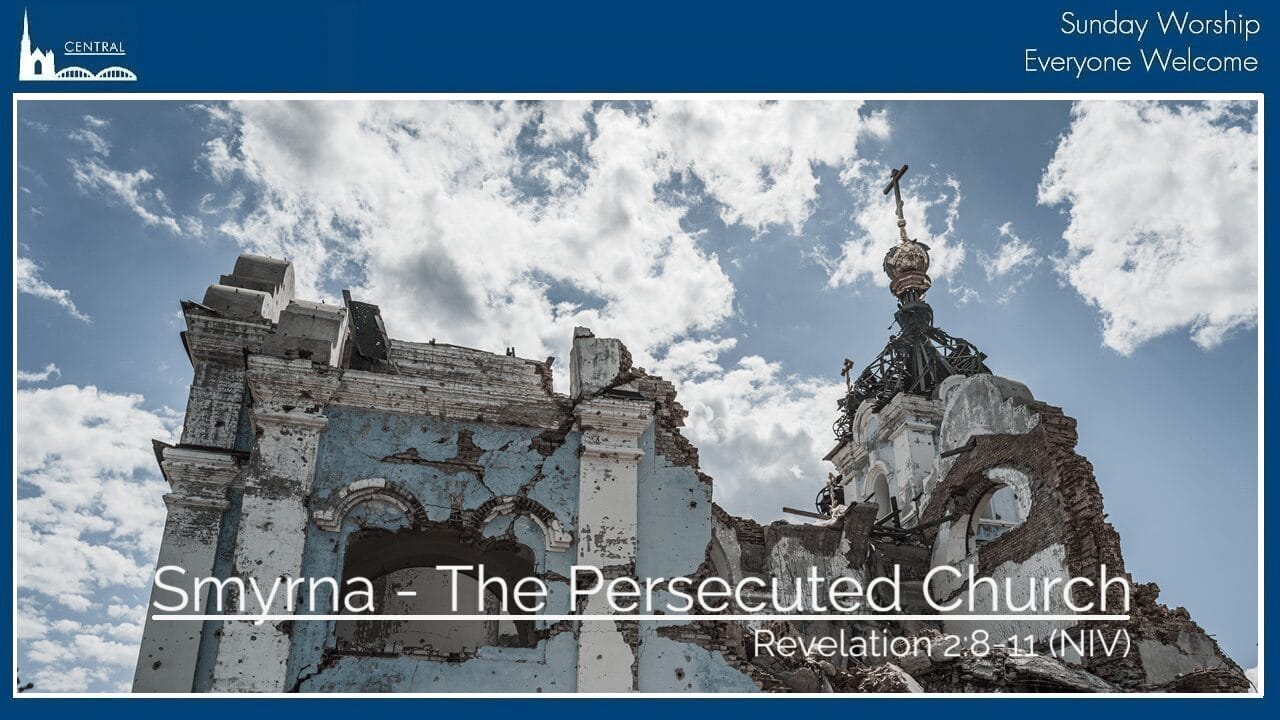
Revelations 2:8-11
To the Church in Smyrna
8 “To the angel of the church in Smyrna write:
These are the words of him who is the First and the Last, who died and came to life again. 9 I know your afflictions and your poverty—yet you are rich! I know about the slander of those who say they are Jews and are not, but are a synagogue of Satan. 10 Do not be afraid of what you are about to suffer. I tell you, the devil will put some of you in prison to test you, and you will suffer persecution for ten days. Be faithful, even to the point of death, and I will give you life as your victor’s crown.
11 Whoever has ears, let them hear what the Spirit says to the churches. The one who is victorious will not be hurt at all by the second death.
Transcript
(Transcribed by TurboScribe.)
Condolences to my brother David Pennington. He lost his brother this week. May God comfort you and your family in these days.
I know the funeral is coming up as well. May the Lord be with you and hold you in this time. My good friend Gregory, who makes sure most of the time we need him out of, but Gregory is on this morning, that the live stream work, except if stuff happens and we don't have it, like last week, Gregory had his 60th birthday yesterday.
I thought you were only about 22, Greg. You got me good there. Happy birthday to you.
We always celebrate these good things together as well. The scripture reading in your bulletin, I don't know where that came from. I am not preaching from Colossians.
It's going to be difficult to find one of the churches of Revelation in the book of Colossians. If that's where you were, you got it all wrong. We're going to be in Revelation chapter 2, verse 8 to 11.
That's where we're going to read. I checked that and I thought, holy Hannah, how did I miss that? I don't know. Lord, thank you that we again will see Jesus and only Jesus.
What a word you have, Lord, for that church and what a word you have for this world and this church. May we have ears to hear, hearts that will cry, and lives that will give. Thank you that we may see you in Jesus' name we pray.
Amen. Before we read, one of the things that we know that we live with in this world is that dividing line between the haves and the have nots. Those who have peace, those who have power, those who have abilities, those who have means, the haves can go on.
But then those below the line, the have nots, that have no peace, that have no power, that have no abilities, that have no means to take care of themselves. Church of Smyrna that we're going to read about this morning, they were on that bottom line of the dividing line. They were poor, they were powerless, they were oppressed, and they were persecuted.
The difference between their circumstances and our circumstances is this. Usually what creates the dividing line for us between the haves and the have nots is the socioeconomic, political things that go on in our lives. For them, the thing that caused this line and created them to be below this line was a thing called their faith, their solid belief in Jesus Christ, their solid giving of themselves for the gospel of Jesus Christ.
That caused them to struggle, really struggle. Let me give you a little background on the church in Smyrna. Ted, just that one slide of where Smyrna is, just so I can give folks an idea of where we are.
So it's in the modern-day Izmir. If you go to Izmir today, Smyrna is about as big as this church built all around the little place that was called Smyrna, despite the fact or what was left. Smyrna was one of the largest cities in that area.
Again, it was a coastal city, harbour city, like Ephesus, the one that we did first. So again, cosmopolitan, lots of people coming in, lots of influences coming in from all over. It was also the, you can call it the beginning or the end of the so-called royal road.
King Darius I of Persia decided that they needed a way to get to the east and get all of their things that they wanted to sell to the east. So we built a road from Susa. You won't be able to see Susa.
If you want to see Susa on this map, you'll have to go way past the white strip and get Susa about here. 1,500 miles of road that they built was one of the wonders of the world. It took you about four months to go from Susa to Smyrna, if you were lucky, and didn't get whacked on the head on the way there.
So this royal road was created, and so again, all of the influences coming from Persia, from Babylon, coming with that into Smyrna. The Smyrna was destroyed, and it's important to remember this when we get to the text in a second, three times. So they knew what it meant to completely be destroyed, and be dead, and then rebuilt, and be alive again, and dead, and be alive again, and dead, and be alive again.
It was amazing to see how resilient the city was. One of the biggest problems in Smyrna was the god that they served. Their patron god was the god called, and Sibyl, this is not your Sibyl.
They called her Sibyl, but you spelt it C-E-B-E-L-E. So Sibyle, or Sibyl, whatever, most people just say Sibyl. It was a vile, despicable, pagan, hateful—I don't have enough of these words to describe the pagan worship of Sibyl.
It was so vile that it was banned for many years by the Romans. That's how horrible this pagan worship was. And one of the things about the worship of Sibyl was that they did not take kindly to anyone who did not want to join them, who was against them.
So if you're a Christian, you're the enemy, and the enemy needs to be get rid of. It was rampant in Smyrna. It was the seat of worship of Sibyl.
So just putting a little bit in that in your head, creating the situation of where this little church in Smyrna, what they were dealing with. I don't know how much to tell you about this. You must go read this up because it is so vile.
I can't really talk about it. They only had priestesses. How do you say that in English? Priestesses.
Did I say that right? Sometimes I get that thing wrong. They would come, and when they brought the sacrifices, they would mutilate themselves. There was a so-called day of the blood, March 21st every year.
They would come, and they would cut themselves with knives and mutilate themselves as they cut, and then spread that blood on the altars and against the walls. People that wanted to join the cult had to do the same thing, mutilate themselves. They did not have any men being priests.
If they wanted to become a priest, they had to mutilate themselves. They had to become eunuchs. They were called gali.
The gali were there to serve the other priestesses. They were so-called oracles because of how they were prepared to give up themselves and become something else. They were the oracles, those who were the mediums, and so they would use all kinds of drugs and alcohol, and then they'd play this music and then go into this trance, and then part of this was the sexual orgies that were going on all the time.
So can I stop there? It's vile enough. They were the pagan sect that started the persecution of the Christians. It wasn't Rome.
They made Rome start the persecution because they were so into everything. So you see where I'm going with all of this. They were so persecuted that one of the first martyrs of the church in around 156 BC was the bishop called Polycarp.
Polycarp was martyred in Smyrna. The story is told that they nailed him to this pole, and then they got the wood, put the wood around him, and lit the fire, but the fire didn't touch him. Then they took him down, and they slaughtered him in the arena.
So they knew all about being persecuted. The bishop was persecuted. They did not have a chance.
The Christians had no chance to start businesses, do well in anything, because if you wanted to be part of a business, you had to join one of the guilds. To join one of the guilds, you had to go through the pagan rituals that were part of that. Only when you've gone through these pagan rituals would you get a certificate that allowed you to start a business, to buy, and to sell, and to do business.
They could not do that. So a really difficult, hard place to be a Christian, and yet the church in Smyrna blossomed despite all of that. So read with me as we walk through this, and this is difficult preaching for me.
You know me. I'm a storyteller. Now I'm doing expository preaching for you, where we're breaking it down a little bit.
So for seven weeks, I'll do that, and then I'll go back to telling stories, which I really like. This is one of the two churches that does not have a rebuke. It only has a commendation.
So it starts, to the angel, and I told you last time it's the word angelos, which means messenger, or it can also be translated as the pastor, to the pastor of the church in Smyrna, right? These are the words of him who is the first and the last, who died and came to life again. I told you they died three times, and they came to life three times. They would understand these words immediately.
Interestingly enough, Smyrna was also called the first of Asia, and now the one who is the first and the last writes to them. But notice the V. He's not just one of the first and one of the last. The one who writes to this church says, I'm the one who was there right at the beginning, and I'm the one who's going to be there right at the end.
Hold on to that, because in the in-between, I will be there. He's not, I'll be there in the beginning, and when the end comes, I'm going to hang around. I'm the first and the last, but everything that comes in between is him, and can we say that to ourselves in the world that we live in too? He wasn't just there, and then he left and went to his father, and now we're on our own and do our own thing, and then maybe one day we'll see him again.
He's there from today until right to the end of this world, with you every day, whatever that might be, in those amazing days of joy and happiness, and in those days of struggle and hurt and pain and need, the first and the last will be there. I was dead, he says, but as you saw the city being rebuilt, that day that I walked out that grave, I'm alive, and I will be with you and alive with you. Then comes this amazing piece, and this is so hard.
I know your afflictions and your poverty, yet you are rich. Holy moly, does that make sense? I know your afflictions and your poverty, and yet you are rich. Let me break this down for you with the two words that are used for affliction, the one and the one for poverty.
The word for affliction is the word slipsis in Greek, and there's a slide for this text that'll help a little bit. So, flipsis, its original meaning comes from when they were torturing people. So, what they would do, flipsis means they would turn or take a rope and put a rope around a person so that they could not move.
Then they would lie them down on the ground, and then they would take a rock, and they would put the rock on them, as heavy as they could get, and leave them there until the rock crushed them to death. That's what the word flipsis means. So, when He says, I know your afflictions, that's the word that the Lord uses for this church.
I know what they're doing to you. I know that they're putting these external pressures on you that is like this rock that is lying on your body. I know your anguish.
I know the persecution. I know what they're doing to you. I don't know if we even have an idea of what that means.
I mean, we come to church, and we're happy. We moan about it's too cold in the church. It's too hot in the church.
The pews are a little too hot. That's our afflictions. I don't like Johnny.
I don't know why Susie sits next to me. Those are our afflictions. Their affliction was this persecution against them was so vicious.
That's how it felt. Lying there, and this rock is just pressing, pressing, pressing, until there is no life left in you. I know that, says the Lord.
I also know that you are poor. There's a slide for this one, too. The word for poor is potrheia.
So it's one of those interesting words again. There is another word in Greek for being poor, which means you don't have a lot of money. You kind of just make ends meet at the end of the month.
This is not that word. This is maybe a word, and forgive me if I'm offending someone, and I don't mean it in that way. This is the word that you would use for someone who is homeless and has nothing to live off and is sleeping under a tree, and they have nothing.
They hope that maybe you give them two dollars to buy a cup of tea or coffee at Timmy's, because they have nothing. They don't live in Canada, where maybe the government will help a little bit. They live in a world where there is nothing for them.
That's the word that the Lord uses for them, because can I take you back to what I said about the guilds and how they would not get the certificates? They had nothing, folks. There was nothing for them to live off, and yet they stood and said, I believe in Jesus Christ, the Son of God, my Lord, and my Saviour, and I won't turn my back on that, and it was fine. It will happen, and it didn't happen, and I look at myself and I think, would I be able to do that? Is my faith in the Lord Jesus so strong? Is my commitment to Jesus Christ of such that when it comes to that point where I have nothing, I do not have a home, I do not have food, I do not have anything to give to my kids, we live off the streets, hopefully there's something, all because I am not prepared to say that I will turn my back on Jesus, I will go run around with these other gods, I will do these vile things, I will be part of this world, and as long as I do that, I'm fine and dandy.
Will I be able to do that? And they did that to the point of death. Polycarp showed that. They martyred him, and the church just continued to grow.
You have such faith. You have such faith. That was more, David, don't you think, than a mustard seed of faith.
You have all these things done, and you see that. I'm going to get to that in a second, and then the word says, I know your afflictions. I know how poor you are, but you are rich.
Really rich. The word that he uses for rich, and I won't use all these Greek words for you. You have to read this text in Greek, all of them.
It's a word that says to have more than abundance. Just look at the opposites, right? It's all the opposites that you get in this text. First, last, alive, dead, rich, poor.
You are poor. You have zip, and they had zip, and yet, says the Lord, you are abundantly rich. What does that mean? Can I tell you what that means? They knew what it meant to be the church of Jesus Christ.
They knew that if brother John needed something, that we would all come together, and we would take care of brother John, because John needed that. They knew that if they saw that little fish where it was pointing, they're going to go into those catacombs, and they're going to be down there, and they are going to be in the presence of Jesus Christ, their Lord, and they will see the work of the Holy Spirit in that church, in those caves down there, where they would be slaughtered if they find them, and they were slaughtered in there. Slipses happened in those, but there, their things happened.
They cared for one another. They loved one another. They prayed for one another.
They saw the miracles of the Holy Spirit of people's lives being changed one by one by one, and that's what made them rich. They never stopped bringing the gospel of Jesus Christ, despite the fact that they would die for that, and they did, and they were okay to do that, because they had more than enough, because they had Jesus, their Lord. We are so rich, more than we could ever think, when we know how to love with the love of Jesus.
Even those who irritate me work on my nerves, and I can love with God's love. When we share and we give, we relieve ourselves. Remember in Acts, when it started, what did they do? They ate their bread.
They prayed together. They loved one another, and the church kept growing. That's exactly where Smyrna's riches was.
I think that I gave you slides for this. Thomas Aquinas. Boy, did he ever get this thing right.
He was invited to the Vatican, and then the Pope took him through the Vatican, and let me read this with you. Thomas Aquinas was invited by the Pope, Pope Innocent IV, to view the breathtaking treasures that had been amassed by the church. With great pride, the Pope said to him, no longer can the church say, silver and gold, we have none.
Do you remember that was when Peter, and they stood there with this person, and they said, help me, and they said, gold and silver, we don't have, but what we have, you give in the name of Jesus. So this is it. No longer can the church say, silver and gold, we have none.
To this, Aquinas replied, holy Father, that's very true indeed, but neither can we say to the poor and afflicted, rise, take up your bed, and walk. Ouch, ouch. We can have all the riches in the world, and all the treasures in the world, but if we do not have the love of Jesus Christ, if the church does not take care of the needy, and the poor, and the brokenhearted, and the struggling, we've got nothing, nothing.
That is our mission in the world. Our mission is not to be this little group that makes each other feel warm and good. Yes, we do that.
We care for each other, but it can't stop here. It needs to go out. I've always said that a church that only works this way will die.
If a church does not work this way, going nowhere. And we need to do that. We need to live that.
We can't say to our brother and sister in need, go, remember, James, go, and be warm, and be fed. See, we need to make them warm. We need to feed them.
We need to care for them, and we need to bring them into the gospel of Jesus Christ so that they can become rich and richer, not with worldly richness, but with the fullness of the riches of Jesus Christ. How blessed we are. How blessed we are that we, who are but broken earthen vessels, have this amazing treasure in us to give freely because freely we have received.
I know your afflictions. I know how poor to the bone you are, but boy, are you. It's not a pie in the sky when we die theology.
It's a live it in this world theology. Forgive me. I transgress.
I know about the slander of those who say they are Jews and are not, but are a synagogue of Satan. Oh, my word, this is so hard. So there was a huge Jewish community in Smyrna.
They were tolerated by the pagans because of their business prowess. They liked the way that they did their business, and because the Jews were persecuting with them the Christians, because the Jews said the Christians are antichrists because they're teaching a different teaching from what they were taught in the Torah. So they went along and persecuted them.
They also slandered, that's the word they used there, said bad words against the Christians, always, always trying to get them in trouble. And now, when you know a little bit about the Jewish tradition, in this day, still to this day, Torah, especially in Leviticus, speaks specifically and says you should not do lashon hara. Hara means horrible, and lashon means say horrible things about other people.
They were not. This was part of their teaching. And yet, what are they doing? They're doing the opposite.
They went a little further, and this is why he calls them the synagogue of Satan. When Polycarp was caught to be martyred, the Jews were the one who gave away where he was hiding. On the day that he was martyred was a Sabbath.
The Jews went, and they got the wood for the fire, and they were there on the Sabbath, despite what does the Sabbath say. You shall not gather wood. You shall not do these things.
You shall not be there. You shall not, says the Torah, slander other people. They did exactly that.
They spoke badly of others. So, can you understand when Jesus says to them, I know the slander of those who say they are Jews, but they're actually the synagogue of Satan. Satan, interesting, and I need to tell you these different words.
Satan, the Greek word that's used here is satanas, which comes from just a direct translation of the Hebrew satan, which means accuser. So look, they slander like their father, the accuser, who's always slandering. Isn't that what he did? He was always standing, accusing us.
And what happened to the Satan? God kicked him out of heaven. He can't slander us anymore. But what is he doing down here? He's going at the Christians, and he's slandering them.
So God says, your synagogue is not a synagogue of teaching, where you come together as one synagogue, as one people together. You're a synagogue of Satan, because you do the works of Satan. Holy, you know.
What a word. Christians, you're poor, afflicted. Why are you rich? But you who do these things, I call you the synagogue of Satan.
May God never say that. Do not be afraid of what you're about to suffer. I tell you the devil, and he uses a different word in Greek.
It's not the word satanos. He uses the word diabolos. The diabolic one will put some of you in prison to test you.
The word diabolos is so, so the right word here. It was diabolic what they did to them.