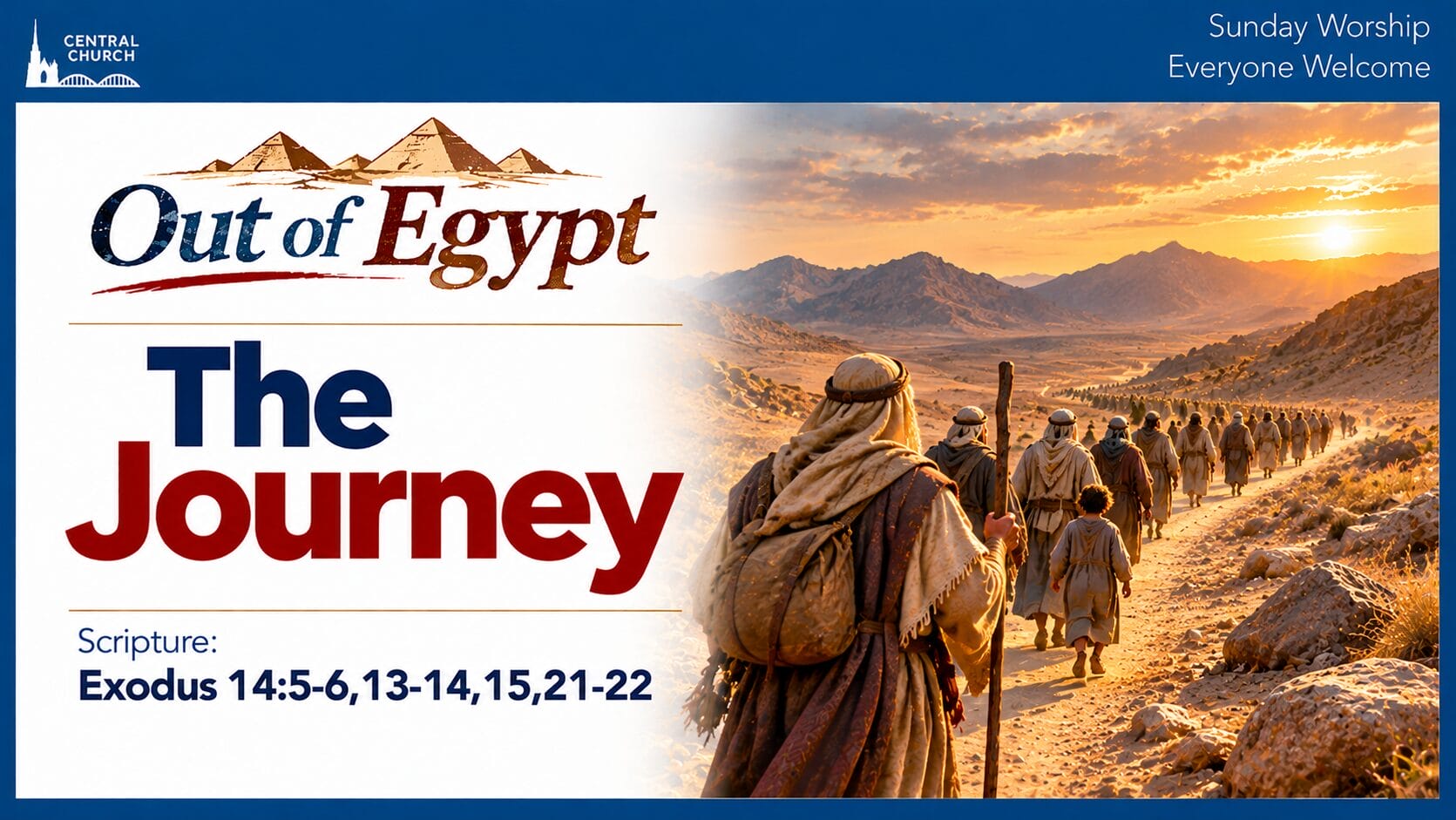
Exodus 14:5-6,13-14,15,21-22
5 When the king of Egypt was told that the people had fled, Pharaoh and his officials changed their minds about them and said, “What have we done? We have let the Israelites go and have lost their services!” 6 So he had his chariot made ready and took his army with him.
13 Moses answered the people, “Do not be afraid. Stand firm and you will see the deliverance the Lord will bring you today. The Egyptians you see today you will never see again. 14 The Lord will fight for you; you need only to be still.”
15 Then the Lord said to Moses, “Why are you crying out to me? Tell the Israelites to move on.
21 Then Moses stretched out his hand over the sea, and all that night the Lord drove the sea back with a strong east wind and turned it into dry land. The waters were divided, 22 and the Israelites went through the sea on dry ground, with a wall of water on their right and on their left.
Transcript
(Transcribed by TurboScribe)
Father God, thank you for these moments. Thank you that we can smile, make a little bit of fun, but thank you that we can smile about your Word as well. Because how amazing is this Word? It speaks into our lives, it speaks about us, and when I read this passage, Lord, oh, you know us from the inside out, isn't that what you say in the 139th Psalm? You just know us from the inside out.
Help us again in this morning as we listen for your Word, that we might see Jesus and only Jesus. Amen. So, just for the two weeks, it would have been three, but then you had this guy preach for the call, so I had to cut one of them.
So, for two weeks, we've been looking at the story of the Exodus. It almost didn't happen. It almost didn't happen because of the fears and the insecurities and the excuses of one man, a man called Moses.
Now, you know Moses. I don't have to tell you about Moses. You know the story of how he was a little baby.
He was put in a basket. His sister waited there. Pharaoh's daughter came, and Miriam said, I can take him to his mother.
His mother can wean him, and then you can have him, and then he grew up in Pharaoh's court, and all the things worked out perfectly. The plan was in place until one day Moses was out walking around, and he saw this Egyptian slave driver beat an Israelite really badly, and he stepped in and he killed the Egyptian. He thought his people would be happy with him, and they were kind of, you're hanging out with Pharaoh.
We don't like you, and all of a sudden, his face was on all the wanted posters in Egypt, and Moses had to get out of Egypt. So, he fled to a place called Midian, which in today's terms would be Saudi Arabia in that area. He fled to Midian.
There in Midian, he met his wife. They married. They settled down.
They had children, and he worked for his father-in-law called Jethro, who was a priest in Midian. He became the shepherd for his father-in-law. Moses felt safe.
He was good. He was living this wonderful life in Midian. Egypt and the bondage the slavery of Egypt long passed, that is, until God decided to step in, and that's where we pick up the story.
Exodus chapter 3. Now, Moses was tending the flock of Jethro, his father-in-law. One day, we can talk about traditions, and I can teach you about that. Some traditions also call him Raoel.
Same guy. Jethro, Raoel, same guy. Just depended on some guys call you Robert.
Others call you Bob. Okay, same thing. So, he tending the flock of his Jethro, his father-in-law, the priest of Midian, and he led the flock to the far side of the wilderness and came to Horeb, the mountain of God.
Now, here we have the same thing again. Some traditions call it Horeb. Others call it Sinai.
Robert, Bob, same thing. There the angel of the Lord appeared to him in flames of fire from within a bush. Moses saw that though the bush was on fire, it did not burn up.
So Moses thought, I'll go over and see this strange sight. Why the bush does not burn up? When the Lord saw that he had gone over to look, God called to Moses from within the bush. Moses! Moses! And Moses said, here I am.
I'm going to stop there for a second. I'm just going to explain the rest of it so we don't read it all. It'll stay here until tomorrow.
So, remember those last words. Moses, here I am. And then God says, Moses, so here's the thing.
I've heard the cry of my people in Egypt. And I can't let them be slaves anymore. So I'm going to lead them out of this land of slavery and bondage into a land that will overflow with milk and honey.
This is what's going to happen. Here I am. Verse 10.
And the Lord said, so now go. I'm sending you to Pharaoh to bring my people, the Israelites, out of Egypt. And we expect Moses to say, I just told you here I am.
Let's go. I'm going to go do this. I'm ready for this action.
Lord, get me on a camel. Let's get back to Egypt. All of a sudden, all of those fears, those insecurities kick in and Moses comes up with four excuses, objections, whatever you want to call them.
And here I need to say the next word in verse 11. But Moses said to God, who am I that I should go to Pharaoh and bring the Israelites out of Egypt? Here I am. Who am I that I should go? Lord, you don't get it.
I'm not qualified to do this kind of stuff. You see what I'm doing. I'm a shepherd guy.
I'm happy in Midian. I'm happy with the kids and with Jethro and the whole works here. Let me be.
And by the way, have you seen my resume? Did you see the last line in my resume? Killer of an Egyptian. Have you seen the one that signs in Egypt? I'm not going. I'm not qualified to do this.
Now, when we read these words, I want us to all think about our own lives as well and the things we say to God sometimes. It's easy to say, I can't be a Sunday school teacher. I can't greet at the door.
I can't sing in the choir. I can't carry this thing up. And who am I? Who am I to do this? I am not qualified.
Now, I want you to listen to all the I's in this passage today. Look at God's response. And God said, I will be with you.
And this will be the sign to you that it is I who have sent you. When you have brought the people out of Egypt, you will worship God on this. Who am I? I. I will be.
You see, it's not about my qualifications or my disqualifications, my adequacies or my inadequacies. It's about God and God's presence in my life that qualifies me. I will be with you.
He does not send you alone. He does not leave you alone. I will be with you.
Who am I? Don't worry about that. Worry about who am I that is standing next to you. I will be with you, Daniel, in the lion's den.
I will be with you, Shadrach, Meshach, and Abednego in the fire. We sang it last week. There's another in the fire standing next to me.
I will be with you, Jacob, when you're running away and you're lying there behind the stone and you don't know what's going to happen. I will be with you, Joseph, when your brothers sell you and when you are in jail in Egypt. I will be with you, disciples, when you sit in the middle of the lake of the Sea of Galilee and the storm is all around you and you're not sure whether that boat is going to sink.
I will be with you. How much more do we know that? Because next week we enter into this beautiful season of Advent, where we are reminded, and you will be born and they will call him Emmanuel, which means God with us. Yes, he's coming, but he's here right now.
I am with you. I'm with you, Trevor and Hazel, when you stand next to that bed and you cry with Aubrey as you try and pray and you can't because you're just overwhelmed, but you know I am with you. I am with you in your loss and in your struggles and in your seeking.
You're not alone. You might feel that you're not qualified, but it's not about you. It's about God's presence in your life, and all I need to do is to open up.
God, who am I? Thank you for who you are in my life. I can go on for the whole day, but let's go on. Moses is still not satisfied.
Verse 13. Now, you must look at this every time, how beautiful how this is written. Moses says something.
God says something. Moses does the eye. God does the eye.
So here again, verse 13. Moses said to God, suppose I go to the Israelites and say to them, the God of your fathers has sent me to you, and they ask me, what is his name? Then what shall I tell them? God said, Moses said, God said to Moses, I am who I am. This is what you are to say to the Israelites.
I am, has sent me. That is one of the most profound words in the whole of scripture. When Moses says, okay, you're saying you're God, but really, who are you? And God says to him, who I am.
In those words, it's far more than just I am who I am. It says, I will be who I need to be. I will do what I need to do.
I will provide what I need to provide. I will give what you need in your life. I will protect when I need to protect.
I will carry when I need to carry. Way more than just three little words. It is not what is on your resume, Moses.
It's what is on mine. I am who I am. Can I remind you of that every day in your life? That he is the great I am? When Jesus came into this world, John loves doing it.
He is so beautiful. He wrote in Hebrew. His letter was written in Hebrew before in Greek.
He loves the I am's. Can you remember Jesus? Stands at the great feast, and when they break the bread, he says, I am the bread of life. Whoever eats from this bread will never be hungry again.
At that same feast, when they light those big old candelabras, he stands there and he says, I am the light of the world. Darkness can never overcome. When a woman had a while of seeking for her life, and she says, I know that the prophet said there's someone coming, and what does he say? I am he, and that I am changed her whole life.
She had the worst resume in the world, and she became an amazing disciple who brought people to Jesus Christ because of I am being I am. And there's a promise for us, last chapter of Matthew. I am with you until the end of this age.
Who will I say? Who am I? I am. But God has a little tongue-in-cheek with that too. Verse 15, God said to Moses, also said to Moses, say to the Israelites, the Lord, the God of your fathers, the God of Abraham, the God of Isaac, the God of Jacob, has sent me to you.
They didn't have resumes, good resumes. Abraham cheated on his wife. Isaac didn't know his two sons, one from the other.
Jacob, oh holy Moses, do we ever have to talk about him? You see, God doesn't always call the qualified. God qualifies those that he called. Who am I? Don't worry about that.
I am who I am. I will qualify those who I call. Look at Abraham, Isaac, and Jacob, and look what I did.
And Abraham said, I'm sorry, Moses said, got it, let's go. Yeah, right. Objection number two, chapter four.
Moses answered, what if they do not believe me or listen to me and say, the Lord did not appear to you? Oh, my friends, that word, what if? Do we know that? Well, what if I don't get the position? What if my life is going to change? What if she doesn't like me? What if I lose my job? What if I don't get into that skill? What if, what if, what if? The problem with the what ifs, they become these little jails for our faith, where our faith is trapped in our fear of the things that we cannot control. You want me to say that again? What ifs become the jail where our faith is trapped in the fear of the things that I cannot? What is God's response to our what ifs? And the Lord said to him, what is in your hand? A staff. He replied, and then God, I'm not going to read that, says to him, okay, Moses, you got a staff, just a piece of wood.
Okay, throw it on the ground. And then it became a snake. And he said, grab it by the tail.
And it became a staff again. He says, when you go to Egypt and they don't believe, you show them that. And then he said, put your hand in your cloak.
And he put it in. And when he brought it out, it was leprosy. And he said, put it back.
And it came out and was clean again. If they don't believe you, there's another sign. And if they don't believe that, then you take water from the Nile, you throw it on the ground, and it will become blood.
Because what is in your hand? What have I given you? Don't worry about what is out of your control. Worry about what you have in your control. Don't get trapped in the what ifs.
Go to the what ifs. So can I ask you this morning, what is in your hand? There's a South African poet. He wrote, I forget his name now.
He wrote this story. And I'm going to say it in Afrikaans and then I'll try and translate. Where he says.
So the guy said to him, hey, what do you have in your hand? And he says, oh, I have a guitar. He says, well, let's sing. What do you have in your hand that God can use? What is in your control that you say this is a gift that God has given me and I can use this for God? What is in your hand? Verse 10, number three of the objections.
Moses said to the Lord, pardon your servant, Lord. I've never been eloquent, neither in the past nor since you've spoken to your servant. I'm slow of speech and tongue.
We don't know whether he had a speech impediment or not. I'm not so sure about that because you read the rest of the story and he was quite eloquent with his mouth. He could say quite a few things to the people.
So just an excuse. He wants to get out of it. Isn't that what we often do? Who am I? The Lord said to him, and you can see God's getting a little more, not so happy with him.
Who gave human beings their mouths? Who makes them deaf or mute? Who gives them sight or makes them blind? Now listen to the eyes again. Is it not I, the Lord? Now go. I will help you speak and there should be an eye in there and I will teach you what to say.
In other words, Moses, your limitations do not limit me. Your limitations do not limit me. All you need to do is to say yes.
That's all you need. Say yes. I will teach you.
I will help you. I will because I am who I am. We can't limit God.
Second Corinthians chapter 12 verse 9. God's strength is made perfect in our weakness. I will. Objection number four.
But Moses, and there's the word again, but. Moses said, pardon your servant, Lord. Please send someone else.
Thank you, but no thank you. I'm not going to do this. I'm not going.
I'm done. Moses never intended to do this. Why? Can I take you back to last week's sermon? Moses, when he heard the word Egypt, was right back in bondage and he heard his insecurities and his fears and they just put him right back there.
I am not going back to Egypt. I'm not doing the Egypt thing. You go.
You leave me be. I'm not going to do what you want me to do. I am over and done with this.
That's what happens when we remember what I said last week. You cannot get out of Egypt unless you know what your Egypt is. And Moses' Egypt was Midian right now because it was his safe place.
It was, I'm okay. I can take care of this flock. I can hang out with my kids.
I'm not going to where it might be something that God asks of me, that takes something from me, that I need to give something, that I use need to use what is in my hand and trust God that God will be I am who He is in my life and what He's called me to do. And God said, that's fine, Moses. I'll find someone else.
Yeah, right. Then the Lord's anger burned against Moses and he said, what about your brother Aaron the Levite? I know he can speak well. He's already on his way to meet you and he will be glad to see you.
Imagine if Moses stayed in Midian. Imagine what he would have missed out. Think about it for a second.
He would have never seen that staff reach out and the reed seed part. He would never have seen that staff touch a rock in the middle of the desert and water comes flowing out of that. He would never have gone up to the mountain of the Lord and see the Lord face to face if he stayed in Midian.
He would never have come down that mountain with the 10 words of God for God's people for always if he stayed in Midian. Imagine what you will miss out if you stay in bondage and you don't say yes because of the insecurities and the fears and the excuses. Imagine what you will miss.
Trust me. Trust me, says the Lord, and see what I can do for you. And we know that not just because of Moses' story.
We know that because of the story of Jesus Christ, the Son of God, who could not think of spending eternity without us and came right down into this world and became I Am, the Emmanuel God, so that we can be set free and I can say yes. Why would I live a life of safe bondage if I can live a life of amazing adventure? And all God asks, say yes. Amen.
Take a few moments of silent prayer. We're not pointing fingers at Moses, Lord. We're just holding up the mirror and looking in the mirror.
I thank you that we could sing a little earlier, I Surrender All. All of those fears and insecurities and excuses, we bring them and we place them before you. We surrender our hurt and our brokenness and our struggles before you.
And thank you, Lord, that you provide because that's what you did for Moses. There was an Aaron, God's little tongue-in-cheek moment for him. There was an Aaron and a Miriam would be with him.
And in the moments when Moses' arms became tired in the desert, they would be there to hold up those arms because that's what you do. That's the great I Am. You do what you do the best, Lord.
You call us. You equip us. Then you send us.
And you are always with us. Thank you that we are allowed to say yes. In Jesus' name we pray.
Amen.