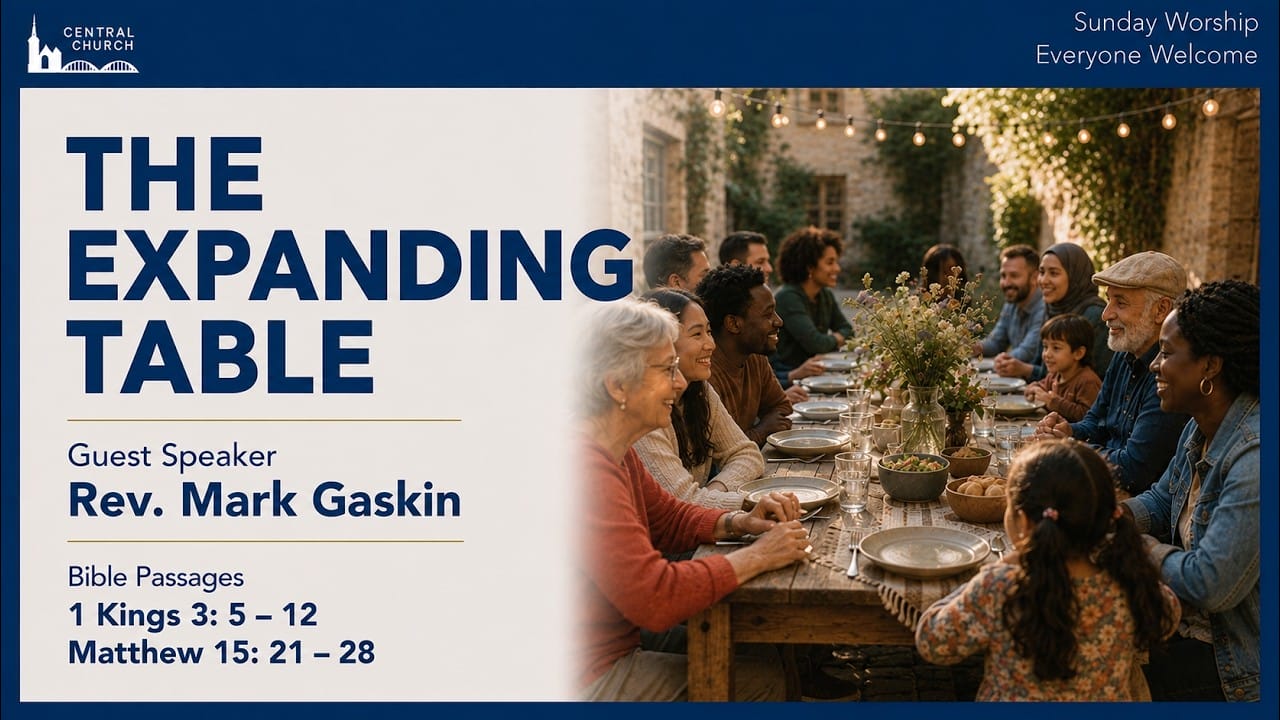
1 Kings 3:5-12(NIV)
5 At Gibeon the Lord appeared to Solomon during the night in a dream, and God said, “Ask for whatever you want me to give you.”
6 Solomon answered, “You have shown great kindness to your servant, my father David, because he was faithful to you and righteous and upright in heart. You have continued this great kindness to him and have given him a son to sit on his throne this very day.
7 “Now, Lord my God, you have made your servant king in place of my father David. But I am only a little child and do not know how to carry out my duties. 8 Your servant is here among the people you have chosen, a great people, too numerous to count or number. 9 So give your servant a discerning heart to govern your people and to distinguish between right and wrong. For who is able to govern this great people of yours?”
10 The Lord was pleased that Solomon had asked for this. 11 So God said to him, “Since you have asked for this and not for long life or wealth for yourself, nor have asked for the death of your enemies but for discernment in administering justice, 12 I will do what you have asked. I will give you a wise and discerning heart, so that there will never have been anyone like you, nor will there ever be.
Matthew 15: 21–28
The Faith of a Canaanite Woman
21 Leaving that place, Jesus withdrew to the region of Tyre and Sidon. 22 A Canaanite woman from that vicinity came to him, crying out, “Lord, Son of David, have mercy on me! My daughter is demon-possessed and suffering terribly.”
23 Jesus did not answer a word. So his disciples came to him and urged him, “Send her away, for she keeps crying out after us.”
24 He answered, “I was sent only to the lost sheep of Israel.”
25 The woman came and knelt before him. “Lord, help me!” she said.
26 He replied, “It is not right to take the children’s bread and toss it to the dogs.”
27 “Yes it is, Lord,” she said. “Even the dogs eat the crumbs that fall from their master’s table.”
28 Then Jesus said to her, “Woman, you have great faith! Your request is granted.” And her daughter was healed at that moment.
Transcript
(Transcribed by TurboScribe)
Alexander:
Our speaker this morning is the Reverend Mark Richardson. Mark is a long-term friend of Central. We're so glad that you're here, Mark.
Mark is retired from Westside Galt and from Central Church in Brantford, and we are so glad that he's here. No, no, we don't have to correct Alexander. I've messed up his name several times.
Mark Gaskin:
And, you know, if I had to be confused with somebody, Richardson is the one I'd want to be confused with. He's a great guy, the other Mark. I don't blame him.
There's something about this presbytery, and Lynn Pennington knows, for a while, there were four, there were at least four ordained ministers in the presbytery of Waterloo West. Mark Lewis, Kitchener, Mark Gedke, also in Kitchener, Mark Richardson, and Mark Gaskin. And the clerk of the presbytery started to give us nicknames.
I have no desire to share with you what my nickname was. So Richardson is fine, Alexander, fine. I did also want to mention that I'm wearing my Camp Kintail shirt.
They're coming to get Alexander. When you confuse me, that's when I, 911. I'm wearing my Camp Kintail shirt because I know this congregation has a deep relationship with Camp Kintail on Lake Huron.
I know Jonathan and Teresa, the co-executive directors of the camp, have worshipped with you, have led worship. Every time I'm up at camp, and I go up several times a year, there is their Sunday suppers. There are also, it's also Kirk and the Cedars.
In fact, there's one today, four o'clock, they worship in the chapel. And then there is a gathering in McDonald Lodge, afterwards a meal in McDonald Lodge. We often go up, myself and our adult children and their children, will have for several years gone up for family camp held in August.
And when I mention to Jonathan and Teresa that I have preached at Central Cambridge or will be preaching at Central Church in Cambridge, they always say to me, please say thank you. They are deeply grateful for the support they receive, monetary and otherwise, especially the men's ministry, that goes up in, is it twice a year or else, spring and fall, and just does the work that needs to be done on that acreage. There's always something, and especially, it used to be that they would close down for the winter.
So there was this spring cleanup and the fall shutdown. It's a year-round camp now. So there's always, there's more to be done.
And I know Jonathan and Teresa and the board at Camp Kintail very much are grateful for the support they receive from Central Church Cambridge. Our first reading is from 1 Kings 3, beginning at verse 5. King David has passed and his son, King Solomon, has come to the throne. It's been a few months.
And this is the dream that King Solomon has. At Gibeon, the Lord appeared to Solomon during the night in a dream, and God said, ask for whatever you want me to give to you. Solomon answered, you have shown great kindness to your servant, my father David, because he was faithful to you and righteous and upright in heart.
You have continued this great kindness to him and have given him a son to sit on his throne this very day. Now, Lord, my God, you have made your servant King in place of my father David. But I am only a little child and do not know how to carry out my duties.
Your servant is here among the people you have chosen, a great people too numerous to count or number. So give your servant a discerning heart to govern your people and to distinguish between right and wrong. For who is able to govern this great people of yours? The Lord was pleased that Solomon had asked for this.
So God said to him, since you have asked for this and not for long life or wealth for yourself, nor have you asked for the death of your enemies, but for discernment in administering justice, I will do what you have asked. I will give you a wise and discerning heart so that there will never have been anyone like you, nor will there ever be. And our good news reading for this morning from the gospel according to Matthew, and this is what I'll be basing the message on today.
Matthew tells us that Jesus withdrew to the region of Tyre and Sidon. A Canaanite woman came from that vicinity, came to him crying out, Lord, son of David, have mercy on me. Your daughter is suffering terribly from demon possession.
Jesus did not say a word. So his disciples came to him and urged him, send him away for she keeps crying out after us. He answered, I was sent only to the lost sheep of Israel.
The woman came and knelt before him. Lord, help me, she said. He replied, it is not right to take the children's bread and toss it to the dogs.
Yes, Lord. Yes, Lord, she said. But even the dogs eat the crumbs that fall from their master's table.
Then Jesus answered, woman, you have great faith. Your request is granted. And her daughter was healed from that very hour.
Amen. In the name of the creator, the redeemer, and the sustainer. Amen.
Once upon a time, a woman came to a Presbyterian church. Let's call it Knox St. Andrews on the Speedy Grand River. And she asked him, would you do a funeral for my dog? I've had this dog many, many years.
A wonderful companion to me. I would like to have a funeral for my faithful dog. Well, the minister was more than a little taken aback.
And he replied with a certain tone to his voice, well, I couldn't possibly conduct a funeral for a dog. Perhaps you should try one of the other churches in town. The woman was polite, thanked him, and started to leave.
And then turned back and she said, oh, just so you can help me when I visit these other churches. Is $500 enough of an honorarium for this type of funeral? And would I make that out to the minister or to the church? There was a pause. And the minister says, you didn't say that the dog was Presbyterian.
I'd be happy to help. I'm glad you laughed. And I am quite sure that many of you have heard that joke before.
But it's easier to tell that joke than it is to deal with this passage. We're hearing Jesus speak in a way that we have not heard before. And we don't hear very often.
Because there's nothing funny about these words. It is not right to take the children's bread and throw it to the dogs. Those words land with a thud.
They sound harsh. They sound insulting. And if we're honest, they don't sound very much like the Jesus that you and I like to talk about.
And it really comes down to that one word. Dog. Now, today, in our culture, in our time, dogs are beloved companions.
They sleep on our couches. They have birthday parties. We sentimentalise our dogs in ways that would have seemed very strange to the ancient world.
And let's not just think about the companionship that dogs offer. Let's think about service dogs. And how that area has expanded over the years.
To include that they once helped disabled or impaired individuals. And now they do a host of activities with that population. And let's think about the working dogs.
That search for explosives or drugs. Canine dogs that protect you and I. That was not the role of dogs in Jesus' time. They weren't pets.
They didn't do anything. They were scavengers, mostly. Wild, dirty animals that wandered the streets.
Feeding on refuse and garbage. To call someone a dog, even in our time, it's not really a compliment. But we have a different understanding.
But to call someone a dog in Jesus' time was an absolute insult. No compliment whatsoever. Scripture reflects this attitude over and over again.
The prophet Isaiah says, Israel's watchmen are blind. They are all mute dogs. They cannot bark.
They lie around and dream. They love to sleep. Dogs were representations of things that were unclean, unworthy.
They were outsiders. They did not belong to any household, any group. And that is exactly what was meant when Jesus said, made that statement.
A Gentile woman comes pleading for healing for her daughter. Jesus answered, I was sent only to the lost sheep of the house of Israel. She kneels before him, Lord, help me.
And then comes the response that shocks us. It is not right to take the children's bread and throw it to the dogs. The point is unmistakable.
A Jewish rabbi who abandons his own people in order to minister to outsiders, to Gentiles, well, that would be like a parent taking the food off the table that's feeding his children and throwing it on the floor, giving it to animals instead. There is no way to soften those words. Preachers try to.
I have tried to in the past. I have said, well, it's a test of faith for the woman. I mean, after all, later in the story, he says, you are a woman of great faith.
Others suggest that he was drawing out her courage by this statement, perhaps. But why not let the story just speak in all of its uncomfortable honesty? Why not hear what was being said? Matthew doesn't hide the difficulty. He lets us hear Jesus exactly as he sounds.
And maybe that honesty is important. After all, this is the same Jesus, the same Jesus who makes the statement. Elsewhere, he welcomes sinners and tax collectors.
This is the same Jesus who touched lepers. It's the same Jesus who blessed children, forgave enemies, and sat down at tables where respected people would refuse to sit. Those are the stories we know well.
That is the Jesus we know well. Why can't Jesus be as complicated as humans are, as you and I are? We're not one person or one thing. We are complicated.
That's our nature. Why can't Jesus be the same way? So when Jesus speaks this way in this occasion, we are unsettled. And perhaps that's where the gospel wants us to be at that time.
The mystery of the incarnation, the mystery of Jesus' birth, is that God became truly human. We say that in our prayers, in our creeds. That's what we read in the gospels.
Jesus had a human side. And every once in a while, we see it. He doesn't just appear to be human or pretend to be human.
Jesus was born a first-century Jewish man. He lived within a culture that drew sharp distinctions between Jew and Gentile, clean and unclean, insider, outsider. The incarnation, the birth of Jesus, meant that God entered a real culture at a real time in history.
He came into the real world with all of its assumptions and boundaries. So sometimes, maybe not very often, but sometimes we might be tempted to see Jesus sort of floating above his time and place, floating above human history, floating above human temptations, drawbacks, limitations. Untouched by the world around him, Matthew will not let us do that.
He shows us that Jesus is genuinely human. Yes, divine, without doubt. That's what Easter is all about.
But in this moment, genuinely human. This is a Jesus who listens. This is a Jesus who responds, who grows.
And that might be one of the most hopeful things in the gospel. Because if Jesus is truly human, then he engages people as real people do. Most of us do not easily change our minds.
I know my wife marks on the calendar the number of times I change my mind. At the end of the year, it's not an exercise I like to go through. Because I think I'm Mr. Flexible.
That's one of the nicknames I've given myself. Clerk of Presbytery never used it, but I think of myself, Mr. Flexible. Oh, sure, I listen to people.
Give me a well-reasoned argument, I'll change my mind. We cling to assumptions. We hold on to prejudice.
We protect the boundaries that comfort us, that we can be sure of, that have always worked for us in the past. Sometimes we are reasoned with. Sometimes we can be challenged.
Sometimes we can be confronted. And sometimes we change our minds. But lots of times we don't.
We cling on to what we know. But look carefully at this story. The woman refuses to walk away.
She doesn't become angry. She's not confrontational. She doesn't become defensive.
She just answers Jesus with remarkable wit and astonishing faith. Yes, Lord. I hear what you say.
You don't throw food from the table to the dogs. Yes, Lord. Yet even the dogs eat the crumbs that fall from their master's table.
It's one of the finest, most faithful responses in all of the New Testament. She accepts Jesus' image. She accepts that characterisation and then turns it inside out.
Is there enough bread for God's children? Sure there is. Then surely there are enough crumbs for everyone else. If God's grace is truly abundant and eternal, then no one needs to ever be hungry.
Her faith is bold. Her persistence is courageous. Her love for her daughter is unstoppable and unmistakable.
And Jesus hears that. He hears all of that. And he allows himself to be changed by that encounter.
He says, woman, great is your faith. And her daughter is healed. This is not a story about someone winning an argument.
It's a story about the kingdom of God becoming larger than anyone could have imagined. Even larger than when Jesus' own disciples, they saw that Jesus was expanding it, making it bigger. But this was still new territory.
This is not what they expected. The boundaries begin to fall. They continue to fall.
The table continues to grow wider. The invitations become larger. The grace of God spills over the edges.
It cannot be contained. Winston Churchill once said, to improve is to change. To be perfect is to change often.
Whether Churchill intended it or not, those words echo something deeply Christian. Faith is not stubborn certainty. Faith is open to the spirit of God.
Faith is allowing ourselves to be surprised. Faith is discerning that God's mercy is always bigger than we could have imagined. And this is where the gospel finally meets us.
Because the question is no longer simply whether Jesus changed. We can debate that in coffee. The fellowship time.
We can have that discussion. The question is, can we change? Can we allow ourselves to learn something from someone that we might have dismissed? Can we allow a stranger to help us grow in our faith? Can we admit that an outsider might reveal something about God? History suggests that's how the Holy Spirit works. Again and again, God speaks through people that we don't expect God to speak through.
God surprises us when God speaks through foreigners and children and the poor and the outsider. Perhaps the greatest miracle in today's gospel is not that the daughter was healed. That is a miracle.
But that has happened before. Perhaps the greatest miracle is that was a conversation where God once again welcomed more people into God's world. Which was always God's intent.
But this was God's Son doing the welcoming. The work of welcoming people into God's world is not finished. That's one of the reasons that Central Church exists.
That's your mission statement. It should be every church's mission statement. A place where God's people are welcomed into God's world.
People still build walls. I know that. We still divide people into insiders and outsiders.
People who spend time discussing who belongs and who does not. I am happy that that's not a characteristic of this church. That every time you gather around Christ's table, you hear this message.
There is enough bread. There is enough grace. There's enough mercy.
There's enough room. The table belongs to Christ, not to us. And everyone whom Christ welcomes is already welcomed.
Every person. Without exception. Amen.
And so be it.