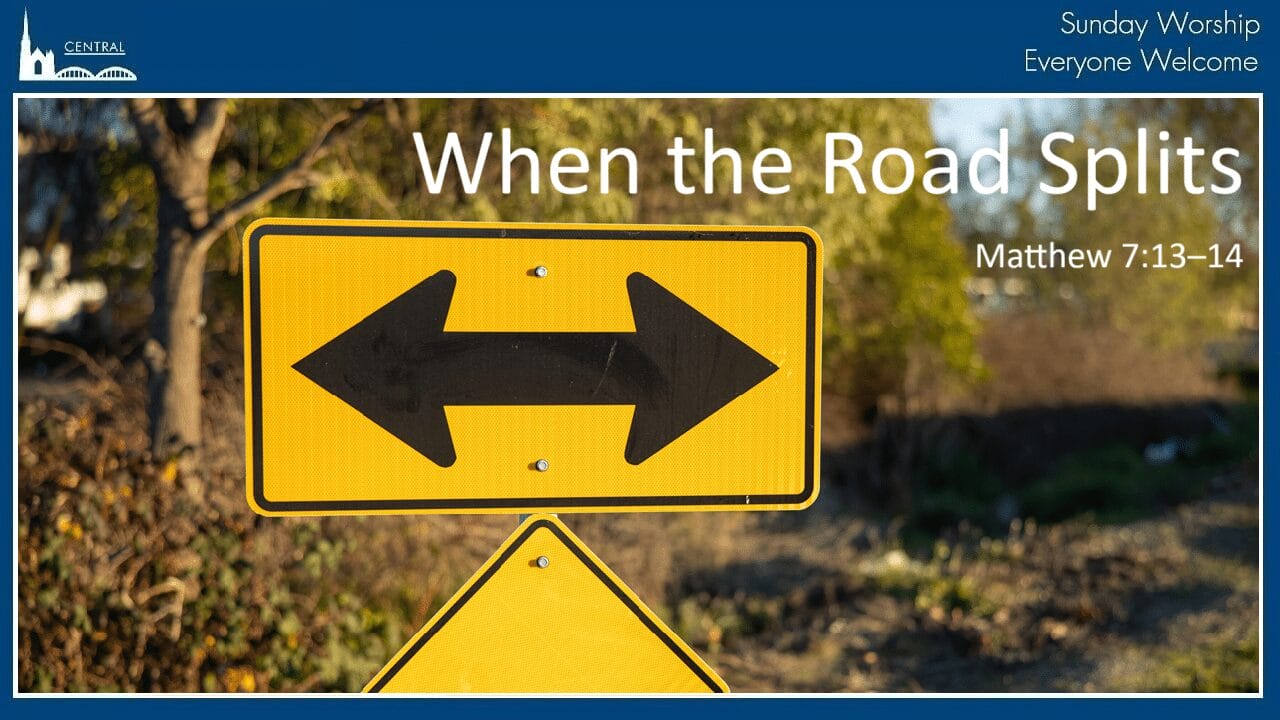
Matthew 7:13
The Narrow and Wide Gates
13 “Enter through the narrow gate. For wide is the gate and broad is the road that leads to destruction, and many enter through it. 14 But small is the gate and narrow the road that leads to life, and only a few find it.
Transcript
(Transcribed by TurboScribe.)
I was a little nervous when I saw that come out and it said churches closed to public. I thought, my goodness, what happened? Something happened since I sat down and I need to ask Peter for forgiveness this morning. I came in and I was just kind of meandering around talking with everybody and, you know, just catching up because I haven't talked to a few for a little while.
And then suddenly Scott came up to me. He says, you got your microphone. I go, oh yeah, I got to do something here.
I got to earn my keep. So I got up and got my microphone. But what I was doing was trying to get someone to come and, you know, stand up here this morning, but nobody would take it.
So when I came in, I leaned over to Peter. I said, you're on. He looked at me and said, what? I could just see the blood pressure just went on.
His face went as white as his jacket. He just kind of, what? I said, just kidding. He says, ha.
But I remember I had one of the very first communication classes I ever took. The person that was leading it opened it up with this. He said, in five minutes, I'm going to call on one person to come up here and do a talk.
So we're going to continue on a little bit, but, you know, just be prepared. In five minutes, I'm going to ask one of you to come up here and just give a bit of a talk for a couple of minutes. So I thought, well, wouldn't that be fun if I came in here and said, in five minutes, I'm going to call on one of you at random to come up here and pray.
All of a sudden, everybody's eyes are looking around. They're looking someplace else. They're looking down.
Internally, you're becoming like King David. You know, you're getting all King James inside. You're practising your Lord, Lord, please come.
And you're working on your best prayer. You're working it up on the inside. But I'm just kidding.
You can relax. I'm not going to call on anybody. Yes.
Yes. Yes. Paul's breathing a sigh of relief.
I'm not calling on anybody. But so I apologise, Peter. So I know Peter, from now on, will be looking to see where I'm seating because he won't want to sit beside behind me or anywhere near me now when he comes in on a Sunday morning.
But I thought that would be a great way to do it. So if you haven't been with us for the last couple of weeks, I've been sharing the last couple of weeks for those you, you know, have come back week after week. Thank you.
I'm glad I haven't scared you off or made you not want to come back into church anymore. I know how much you love Aubrey. I love Aubrey, too.
And he just has an amazing way of unfolding words and just, you know, just teaching things in new ways. And I just absolutely love it. You know, my style is a little bit different.
And so I'm grateful when I see people. And I get asked to come back, too. It's really, you know, that's flattering in itself.
Like, Jim, can you come back? Oh, yeah. They still like me. So anyway, so if you haven't been with us, I know it's summertime.
How many have gotten away for a little bit through the summer? I see a couple hands go up. You've done a little bit of travelling, a little bit of vacation, a little bit away from work or whatever you do. How many are looking forward to doing something yet this summer? Oh, a few more hands.
So you still you're anticipating some, somewhat. But I know through the summertime, a lot of us are off. We're doing different things.
So so if you haven't been with us, I want to kind of recap us because through these four weeks, we're going to spend a little bit of time in Matthew around Matthew seven. So, you know, in Matthew five to seven, that's the Sermon on the Mount. That's where Jesus is.
There's more red letters in those sections than any other section in the Bible. Right. That's where he did a lot of his teaching, unpacked a lot of things.
He just kind of blew people's minds with the stuff that he was sharing and doing. And so we want to spend a little bit of time there. And so the first week we talked about seeking first the kingdom of God.
We talked about just not being judgemental. You remember that we talked about, you know, when you pull up to those traffic lights and you see somebody asking for a change at a traffic light or trying to go into a grocery store and you ask them not to judge. Right.
Because we talked about how the judgement we use on other people is the measure that is going to be used on us. So the fingers that were pointing at others, remember, there's three pointing back at you. So we've got to remember that as we're using judgement because we have no idea what their story is, do we? I took my recycling out yesterday on Friday, sorry, two days ago.
I took it out and I noticed somebody walking up the street. You may have seen this, might be familiar on your street, somebody walking with a couple of grocery bags, looking for bottles and recyclables inside the recycle bins. And I saw somebody, an older guy walking up the street and I thought, well, I've got a few out there.
I usually save it for my wife and my wife, that's her thing. She takes it back and she likes doing that. So I usually keep them aside.
But I saw him walking up and I thought, well, I'm going to put a few out there just to make the walk worth it for him. So I put a few bottles and a few extra cans out on the street. And I went back and I got the rest of the recycling, came out and he was just walking up to the curb and I said good morning to him.
We chatted a little bit and he stood there and he stared at this pile because it was more than what he had in any of his bags. It was just this pile of bottles and he looked and he went, I said, yeah, it's yours. I said, I wanted the walk to be worth it for you this morning.
He smiled. He said, well, I really appreciate that. He started loading it up and we started to just have a little conversation.
And he mentioned his children and he says, yeah, he says, my kids, you know, he said, they're always at the age, you know, he said, doesn't matter how old I get, they're still my kids and they're always calling me up going, dad, have you got any extra money? And here's this guy walking the streets, gathering bottles and cans. And who knows that he isn't just taking that to give to his kids. And I walked away thinking I can't judge anybody coming along and doing that.
All I can do is encourage them. Because the truth is I have to look at my own life and, you know, the decisions he made has gotten him into the place that he's in, right? Just the same way as the decisions that I make and the decisions that you make have gotten you into the place that you are. And we can all look at our own decisions and say, what are the best choices? Am I making the most of my talent? Am I making the most of opportunities? Have I been wise with the things I've been given responsibility over? Right? So we can look at how we use things, how well we manage things, how we look, but it's easier to look at other people and judge them, isn't it? Oh, they're not doing well because they did such and such.
Or they're doing this thing and they're doing that thing. And it's easy for us to judge. But what we looked at, Matthew, encouraged us not to judge because that same judgement is going to be used on us.
So it gave us a different frame of reference to look at things. And then last week we talked about asking and seeking and knocking, right? We've heard that. We've read it over and over times.
You know, ask and it will be given. Knock and the door will be open. You know, and all that stuff just to seek and you will find it.
We hear that over. So we dove into that a little bit about asking. And so oftentimes we don't have because we don't ask.
And we don't find things because we give up seeking. We don't knock on doors because we think, well, it's not going to open up anyways. There's no sense knocking, right? So we kind of disqualify ourselves before we even do anything.
But Jesus came and it's interesting how he flips everything upside down, right? The whole kingdom of God is just a, it's an upside down thing, right? Jesus, you know, when he was asked, like, how do you become the best and sell everything and follow me? That doesn't make any sense. All my possessions, I'm following you. Well, who's going to be the greatest? The greatest in the kingdom will be last.
Whoever's first will be last. Whoever's last will be first, right? Flip it upside down. And so the whole thing about the kingdom is upside down.
Even how Jesus came. I mean, back then the religious leaders, they were looking for a leader to appoint. They were looking for somebody that would qualify for the position.
Be similar to us looking for election day, right? We're looking for qualified leaders. We're looking for people that have done the stuff. We're looking for people that can manage, that can do things, that have got some experience.
They've got some life experience, business experience, that can lead a country and lead us into the next thing. We're not looking around at the kindergarten schools, looking for little kids and saying, there's our next leader. Well, what did Jesus do? You know, what did God do? He came as a baby rather than as a full grown person, ready to step into that position.
God said, no, I'm going to take, and I'm going to bring him up. I'm going to raise him up into the, into the person I want him to be. Flipped everything upside down.
So we looked how the kingdom of God is just upside down. It's completely opposite. And that's why Jesus says, seek first the kingdom of God and everything else will be added unto you because he knows, he said, I know that you need the food.
I know you need clothes. I know you need a place to stay. I know you need all those things, but seek me first and everything else will be added up to you.
Flipping everything upside down. Everything that he did was flipped upside down. You know, I couldn't help, but think of, you know, the first Adam, you know, God moulded Adam out of the dust, right? Just the dirt just formed and made a human being, blew into his nostrils and he became man.
And then he put him to sleep, took out a rib, made eat, right? So now we've got Adam and Eve, three chapters in, blew it. So Jesus said, God said, I'm going to do something different as I bring in the Messiah, as I bring in the King of Kings, Lord of Lords, as I bring in this new, I'm going to bring it in a completely different way. I think it's just fascinating how God turns things upside down.
Today, we're going to look at the narrow gate and the wide gate. Should be fun, right? Everybody's like, yeah, sure. Well, let's, let's read in, in Matthew.
I was just telling somebody that I can't drink coffee too close to when I speak, because that gets me out of hums and here I am with the hums. In Matthew 7 verses 13 to 14, it says this, enter through the narrow gate, for wide is the gate, and broad is the road that leads to destruction, and many enter through it. But small is the gate, and narrow is the road that leads to life, and only a few find it.
It's so much easier to take the easy road, isn't it? To take the one that's wide open, the one that's just easy to step into, easy to get into, because we've been kind of pre-conditioned with that in, in life today, haven't we? Because we don't have to get in our car, drive 30 minutes to go to a mall, get out of our car, go into a store, buy something, get into our car, drive another 30 minutes back home again. Now we can just go up and click on Amazon, order it, and get it the same day, if not the next morning. If we're hungry, we don't have to drive to a restaurant, park the car, go in, wait to be seated, sit down, get the menu, wait for them to take our order, take our order, then wait for the food to come, and eat our food, and get, and tip them finish, and go onto our car, and go home again.
Now we can skip the dish. Now we can call up Uber. We can get most of our favourite restaurants, and just have it delivered right to our front door.
So we're so conditioned to have everything so easy. There's an expression that says, doing today what is easy, will make the future hard. But doing today what is hard, will make the future easy.
But it's so much easier just to do the easy thing, isn't it? I mean, I wouldn't have to give a lecture on how to eat healthy, would I? Is there anybody in here that doesn't know how to eat healthy? Not one hand. But it's so much easier to bag a bag of chips than it is to go and get the apple, right? It's so much easier just to do that. It's so much easier just to sit on the couch, rather than to get up and go for a walk.
How many know that going for a walk is much better than sitting and watching TV? Yet North America, we spend about eight hours a day watching television, because it's easy. Everything has come to us. I was born and experienced and lived life before internet.
How many here know what I'm talking about? You've lived life, you've experienced life without internet. How many can remember when TV was just black and white? Say it isn't so. Everything's supposed to be in colour.
Yes, you had to get up and turn the thing, then you had to turn the aerials, and you had to stand there with your leg out. Yep, that's it. I got the hockey game.
Don't move. Right? It was more challenging there. But now we've got everything at our doorstep with the internet.
I can still remember when we got our very first computer and we hooked up the internet. And I sat in front of this monitor, thinking that I could press any combination of keys and have anything I want, and anything I don't necessarily need, to come right in front of me. I thought, wow, what incredible opportunity.
What incredible power. Gone are the days where we had to get up and go across the street and go to that thing called the library. Right? The library, for those of you who don't know, is that red brick building that's on the corner adjacent to our bed.
It has books in it. And you had to go in there, right? You had to go in there before, think about what you wanted to look up, go over to the drawer, pull out the drawer, try to remember how to use Dewey Decimal. We've got to have a talk with that guy.
Dewey Decimal System. We had to look up the Dewey, and then try to go down the row and find the book that we wanted, and then actually read and consume it. Whereas now we could just go online and get anything that we want.
We can hit our Apple Watches. We can see the new glasses that they've got. Google's got these new glasses now.
You can just talk to them and it can bring up stuff on the screen as you're going. It's like, you know, like you could figure out anything and you get all this stuff read. It's kind of like being, what was that? Mission Impossible.
You know, it's kind of like having one of those glasses, those super futuristic kind of glasses where you're reading all this stuff. But we have all that availability. And it makes it so much easy.
It's so easy just to do stuff. And so is it any wonder why it's easier or more favourable to choose the easy road than it is to choose the hard road? So it all comes down to, we come up to a crossroads, right? We all come to a crossroads where we have to make that decision. Whether we're going to take the easy road, or we're going to take the hard road.
We're going to do the things a little bit tougher, a little bit more challenging. We all come up to that crossroads. Jeremiah 6, verse 16, it talks about that.
And it says this, it says, sound at the crossroads and look. Ask for ancient paths. Ask where the good way is and walk in it, and you will find rest for your souls.
So here's Jeremiah, Old Testament, right? Hundreds of years ago, thousands of years ago, saying when you come up to that crossroads, there's ancient paths, there's hidden secrets in there. God has woven into the fabric of our planet, woven into the fabric of the universe, wisdom, and knowledge, and understanding. And what he's saying is, stand at that crossroads.
When you stand at that crossroad, you have to decide whether to go take the easy road or take the more challenging road. Ask for wisdom. But how do we know, right? Because we're so influenced by things on the outside now, right? How many notice that, you know, the more media expands, the more influencers rise, the more noise that's out there, and they all sound pretty good sometimes, right? They can sound really wise.
They can sound really smart. They can sound like it's the right thing to follow. Well, so how do we discern what to follow, who to follow, who to listen to? So I'm thinking of three things that we could do.
One is we need to pray and ask, right? That was part of what we talked about last week. Seek, knock, ask, you'll get it. But part of that is discerning God's voice, discerning what he's saying.
When we read a passage of scripture, we have to look at it and say, okay, is this real truth, is this real wisdom, or is it my interpretation based on how I was influenced by all the other stuff that's going on in the world? So we need to discern what's going on. And we can only discern that by practising being in his presence, by spending time in relationship. It doesn't happen just on Sunday mornings from 10 to 11 a.m., just saying.
Starting Monday at 6 a.m. up till Saturday at midnight, you know, when we go to bed and get prepared to come into church, that's where we need to walk out that stuff. That's where we need to spend time with him to get to know him so we can discern what's going on. The second way is to ask people, ask trusted people, ask wise people.
You don't want to go ask somebody that weighs 600 pounds and sits and watches television 12 hours a day the best health routine to take. Does that make sense? That's not probably the best advice to take. Or someone that you know won maybe a half a million dollars in a lottery a year ago, and a year later they have no money, nothing to show for it, and a pile of debt.
That's probably not the best person to ask for financial advice, right? Instead, we want to find people that have had some degree of success in the thing that we're seeking, in the decision that we need to make. And crossroads can come at any particular time in our lives. It doesn't matter how young we are, how old we are.
I shouldn't say old, how experienced we are. That's a much better term, isn't it? Young and experienced. I'm 65 years experienced.
That's a much better ring to it. So it can happen at any length. I mean, when somebody's young, at five years old, imagine getting five dollars at five years of age, and then being let loose in a candy store.
Crossroads! What do I buy? You know, all the bubble gum. Do I divide it up? Do I get all these things? Or do I keep this five dollars and maybe put it in my piggy bank and let it grow and accumulate so I can buy a bike or something else, right? So there's a crossroads. Even when we're young, as we get older, there's crossroads in relationships.
They can happen no matter how young or how experienced our relationships happen. And choices need to be made. Do I need to, do I follow this person? Do I go out on this date? Do I listen to them? Do I call them back? Do I try to work out this relationship? We have to go through that.
So there's crossroads. So we need to bring people into our lives that have experience through that. It's probably not a good idea to talk to somebody that's been divorced ten times and ask them over relationship advice.
They might give you a very one-sided, one-sided advice. I remember I had a conversation with a person. This man had been married four times.
This is a true story. Four times he'd been married. He's working on number five.
We got talking about relationships, and he was talking about how challenging they were, how difficult they were, how hard they were to navigate. And I said to him, I said, do you think that maybe you have something to do with it? Oh, no, it's not me at all, right? I thought, well, you're going to be working on number six, right? It's coming to you. So it's choosing the right people to ask for wisdom.
Ask the right people, right? Crossroads can happen in careers, in choosing schools, in, you know, do I accept this one? Do I go to this one? Do I not go to that one? We need to ask for wisdom. So we need to get people into our lives that can encourage us and support us. The third way is to read.
You know, most authors that write books have probably five, 10, 20, 30 years of experience that they've condensed into a couple hundred pages. So you can get 30 years of wisdom in one book. How many think that that would save a whole lot of headaches if you learned, if you read a couple of books like that from someone that's gotten 25, 30 years of experience in any particular area that you want to grow in, how many think that could be beneficial? That would save you a few headaches, right? That would bring you to the front of the line, whether it's business, relationships, finances, health, vacations, choosing schools, whatever it is.
There's so many different books that we can read that will support us and get us to where we want to go because they poured out their wisdom, their experience, their trials and errors, so you don't have to repeat them. Wouldn't that be nice? How many have been through enough experience in life, in relationships, in business that you're like, man, I want to skip through and not repeat that ever again? Been there, done there, got the t-shirt, right? And we don't want to experience those again, yet oftentimes we do because we come up to a crossroads again where we need to make a decision, we need to make a choice, and they could be small choices. Do I watch that extra Netflix show or do I get up and mow the lawn or go for a walk? Do I sit down and watch that movie? It's only two hours and 12 minutes long, so I watch that movie or do I go read a book? Do I do call someone? Do I, you know, we come to crossroads all the time.
The secret is desiring to discipline ourselves. I know that's a terrible word. Some people dislike that word.
They put it up there with swear words. It's like, that's a bad word. Just discipline? No way.
So we need to apply these in any area of life, and I asked Alexander to bring this out because I wanted to share five steps that we can apply to any life, any area of our life, and it will give us a framework that we could use to discern through it, to work through it. Would that be helpful? I see a couple of nods. I see a couple of head nods, like they're falling asleep already, but no.
So let's go through that. So the first thing we need to do to discover any success in any area is to focus on what that area is. Does that make sense? Right? We need to focus on what it is.
So let's pick on health, right, because we all want to be healthier. How many here want to be healthier? Right? We all want to be healthier, right? I'm 65. I'm doing okay, but there's still things that I need to adjust and I can do better, and my, you know, doctor keeps reading the right act to me and telling me, you know, what I need to do better.
It's kind of like a dental hygienist, right? You can never do anything right, right? It doesn't matter how much you floss, how much you brush, how well you, how many apples you eat. You go to your dental hygienist and they're like, well, you can do better with this, right? You get it all the time, not to pick on a dental hygienist, but you can't please them. It's kind of like a doctor, like you go into the doctor, doctor's, yep, this is, but you can do better over here, right? They're always picking on.
So the first thing we need to do is we need to focus on what it is. So is it a relationship thing? Is it a fitness thing? Is it a health thing? Is it a financial thing? Is it a job thing? What is the thing? Is it a spiritual thing? Is it, do I want to become a better follower? Do I want to begin to apply all the years of knowledge that I've accumulated coming to church and begin to apply that in my life? So we have to focus on what that is. We need to pay attention because I guarantee around anything that we want to work with, we've got a script, we've got dialogues that we tell ourselves.
Oh, don't get up and turn off that Netflix show. You've worked really hard today. You deserve to watch that extra show.
Just, just sit back and relax. You've had a tough, tough, tough, tough day. So just relax and have another, watch another show, right? So we, it's easy to convince ourselves of that.
So we need to focus on what that is. So focus on what the dialogues, what the scripts are that we're saying around that. As I said, you know, there's no, we don't need to have a class on how to eat better because we all know bag of chips bad, eating an apple good.
We all know that, right? So we need to focus on it and say, okay, how can, what is the script? What is the things that I'm telling myself? What are the lies that are going on? What are the lines that are running through my mind when it comes to this particular area? Whatever it is, you fill in the blank, whatever you want to do. The next step is to record it. So begin to write down those different things, write down the scripts, write down the lies, the lines, the stuff that starts playing through your mind around it.
Oh, you know, like it could be as simple as, oh, you can't become a better Christian. You're just, you're just, you're just, you know, you're just born to sin. That's just what you're born to do.
You can't get any better. So just forget about it, right? So we need to look at those lies and say, what are those lies? What are the things? And begin to record all those things. And as we begin to record them, we can start to see a pattern.
We start to see a list of things going on. And some of these experiences will go way, way back. And then we can begin to record where they came from, right? How did they even start to run around in our minds? Did we learn them somewhere? Did we pick them up? Did we develop them ourselves? Where do we get them from? We can begin to look at all those things.
Once we've done that, then we can start to make a plan. Now we can come up with a plan. Okay, I know what's going on.
I know what I want to focus on. I want to focus on my health. Okay, and these are the lies that I tell myself.
You know, Jim, you've had a rough day. It's okay to eat a bag of chips. It's all right to do that.
It's fine, right? We can begin to do that. Now we can make a plan. Say, okay, you know, every time I go to, you know, I'm going to buy a shock collar.
And every time I go towards the pantry, I'm going to give myself a shock. No, I don't recommend that. I'm just joking.
Just joking. Okay, but we can start to create a plan. We can start to think about.
We can start to look at what other people are doing that are successful in the area that we want to improve in. What are other Christians doing that are developing good, healthy prayer lives or good, healthy reading habits? What are people doing that are trim and fit? What are they doing? What exercise routines? What kind of lifestyle changes are they making in order to get there? How are they beginning to separate their emotions from their eating, right? We've got to look at that because, you know, we're, I won't get off topic. So once we make a plan, then we can environment.
Sorry, sometimes I can't talk and spell. So now we look at our environment. Once we focused on what we want to change, what we want to be successful in, we've recorded all the dialogue and all the stuff that's going around, and we've created our plan.
We know how we're going to execute our plan. Now we need to look around and change our environment. How many know that if your kitchen cupboards are full of chocolate bars, Twinkies, cupcakes, chips, what other crutches that we got hiding in there? Yellowed a couple other things that might be hiding in the pantry.
Cookies. Sorry. Candy.
Yeah, candy. Yeah. Ice cream.
Yeah, the ice cream is hiding in there someplace. So we now need to look around our environment, and now we need to clean up our environment so it's conducive for the success that we want, right? Because we can't be a successful healthy eater if we're surrounded by junk. So we need to clean up the environment.
We need to start making healthier choices more available. So it's easier. You want to be able to trip over the bag of apples on your way to try to steal a cookie.
So you go, oh, I should maybe move that. No, I should maybe eat one of those, right? And so we want to set up our environment so it's successful. And we could do the same thing if it's a financial thing, right? If you've got buyers-itis on Amazon-itis, and you want to click that buy button, buy now, get now, have it delivered now.
If that's the problem, then block the website. Don't allow yourself to go in, or don't go unsupervised. Have someone with you, no matter what age you're at.
So we need to set up our environment so it's conducive for the success that we want to have. So now we've got those four steps. Here is the final step.
This might be an important one. It's to take action. It's to take action.