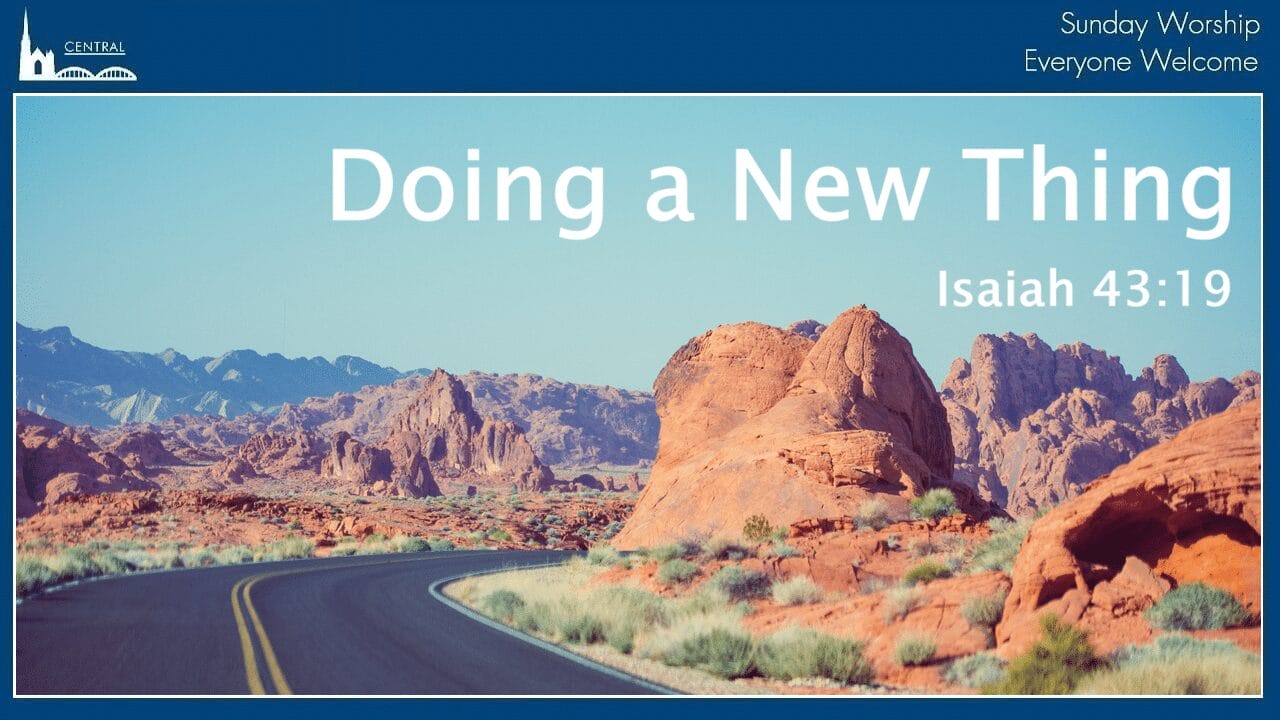
Isaiah 43:19
19 See, I am doing a new thing!
Now it springs up; do you not perceive it?
I am making a way in the wilderness
and streams in the wasteland.
Transcript
(Transcribed by TurboScribe.)
I thought you were getting ready to preach with that one, Scott. I was just getting happy around here. I was thinking it's my lucky day.
Thank you to our worship team. And there's more of them, but this morning, Matt on the piano, and Lou on the guitar, and Gary and Scott singing, leading us here. I said the guitar? Sorry.
Your guitar sounded good, Lou, I mean on the drums. And then Jay on the guitar. And Annette, for the first time, I heard you playing with Lou.
Thank you. And Mackie. We just expect them to be here.
You know, we don't pay them. They're just giving of their gifts every Sunday at being here. And there's more of them that play and are part of this team.
This was just the team this morning. We don't even have a bass man today. Thank you.
These are gifts that God gives. And this is how a church works, right? Remember what God said? We have a body. And the body has fingers and noses and ears and toes and all kinds of stuff.
And for it to work, they all need to kind of give a little. And this is part of those that just give. So thank you.
I have some sad news this morning. Remember last Sunday I told you Sandra Goodman is really, really sick. And she's in hospital.
And she still is. But they have taken the machines off. And she's in comfort gear.
Which is really, really, really sad news for all of us. Pray for Jodie and Jennifer and John and the grandkids. They're there.
John is coming from B.C. Hopefully he'll be in time. He's landing this evening. So I'll go visit with him after church.
But if you just keep them in your prayers, please. They need us in this time. It's a tough time for them.
Sandra was working at BBS just a week or two, three ago. Father, we often pray this. We say that we want to see Jesus.
And only allow us this morning again to do that. And as we walk through your word, thank you for this gift that you have given. Thank you for the word that speaks into our lives.
Help us then, Lord, to allow the word to touch our lives in so many ways. Help your servant, Lord. Let him disappear.
And you can be seen and you alone. In Jesus name, amen. I have a confession to make.
So I write my sermons way ahead of time. Tell you the truth. I am done with this year.
I'm starting my next sermon will be the one for January. So I'm a little ahead. They're all written, done.
So the sermon for today was written 10, 12, 14, whatever weeks ago. So when I sat down to study the sermon for this week, it was just like, whoa, it's 10 pages. Why did I do that? Because I never do 10 pages.
And as I read and as I read, it was like, it's not working. I spoke to Lynn and she just nailed it. She said, sometimes when we write it so long, it's because we don't know what we're trying to say.
And she was right on the money. My son Stephen said that to me one Sunday. He said, Dad, your sermon was like you were flying a plane and you were circling and you were circling and you never put that plane down.
And this sermon felt like I'm circling and I'm not putting the plane down. So I wrote a new one. The problem is I sent all this stuff.
They have it, all of this stuff. Grace put it in the bulletin. It was all good.
And I write it and said, Grace, we're going to change the scripture reading. That's fine and dandy, but the bulletin is a mess. It's all my fault.
No one else. We also changed the song. I called Carrie and I said, Carrie, there's a song that will work so well with this sermon.
Can we change? And she said, we're fine. We'll do it. So sorry.
The bulletin mess is my fault. But the sermon, I just knew that that was not the sermon. So forgive me.
So I wrote something new for you. If you've ever been to the desert, and some of us have. Of course, you guys were with us when we went to Dubai and we went in the desert.
And you look at the desert. Sometimes it can be this place of contradiction. For a moment, when you look around, it's just kind of sand and more sand and more sand.
And it's hot and it's inhospitable. The next moment, you walk over the dune and there's this beautiful, beautiful oasis. Lush, green.
Now, I don't know if you've noticed that the theme of the desert is a very important theme in the Bible. It plays this huge role in the lives of people and usually as a place of preparation. Let me give you an example of what to Moses.
Before Moses could lead God's people through that desert for 40 years, God took him to the desert first. And there he was being prepared for what he was going to do. Before God's people ended in the promised land, they wandered in the desert for 40 years.
But here's the thing. We often look at that as a difficult time. You go read the book of Hosea.
Go read Hosea chapter 2. Start verse 14. They mess up and they're turning away from God. And then God says there in chapter 2, verse 14, he says, I will take them back to the desert and there I will love them again as I would love a young woman.
And they will turn back to me and they will remember the time of courtship in the desert. So in the Hosea's eyes, this was a time of courtship where they were learning about who God is and building this new relationship with God and learning who they were. Paul, before Paul starts his ministry, after his conversion, did you ever read that in Galatians? He goes to the desert of Arabia for three years and then he starts his ministry.
And of course, the one that we all know. When Jesus went to John the baptizer and he was, remember, he wasn't John the Baptist, right? He wasn't a Baptist. He was a presbyterian.
Sorry. When Jesus went to John the baptizer and John baptised him, you remember what that is, right? Before his baptism, Jesus never did a miracle. Never called a disciple.
Never preached a sermon except on his bar mitzvah. But then there at his baptism, the Holy Spirit comes down from heaven and anoints him. And in that moment, he starts his ministry.
But where does he go first? Into the desert for 40 days. The desert in the Bible is a place of preparation. But it is also this place that says something new is going to happen.
It's this place of opportunity. Now, the reason I start like this is because I think I've got it right that all of us have had our desert moments. And some of us might right now be in one of our desert moments.
So I want to take you to this beautiful promise in the word of the Lord. Father, this word is a word of life. A word of preparation.
A word of calling us to new things. Open our hearts for this. Isaiah 43, I'm going to start reading in verse 16.
Now, you know, Isaiah 43 is the one that Alexander has written down for my moment today. Then I say goodbye to this world. This is verse 16.
This is what the Lord says. That's an important line. In the Hebrew, it's a huge, huge, huge moment.
In Hebrew it says, This is what the Lord says. And when the prophets use those words, they're making sure that people know this is not just me and these are the words I got. This is God saying this.
This is what the Lord says. You know what the Lord's talking about, right? The exodus. When they went through the wheat seed.
And then when the Egyptians followed them and the chariots that got stuck in God. This is what the Lord says. Forget the former things.
Do not dwell on the past. For see, I am doing a new thing. Now it springs up.
Don't you perceive it? Don't you see it? Don't you know it? I'm making a way in the wilderness or the desert. And streams in the wasteland. Don't you see it? I am doing a new thing.
What a beautiful promise. To each one of us. When you look at your life, see, I'm doing a new thing in your life.
There will be streams of water. There will be a path even in the desert. Three invitations I want you to notice from this beautiful, beautiful passage.
The first one, verse 19, see. Just the word see. Sometimes the translations will say behold, which I think is a really cool word.
Because the word see in Hebrew is the word hinei. Hinei carries within it more than just see. It's this, be alert.
Pay attention. Look up. There's something that's going to happen.
Be aware of what's going to happen. Don't just sit there. Behold, see.
One of the best examples of that, this word behold, this word see, comes from, and I'm going to the New Testament for a moment, because the New Testament word is idu, which is the exact same word as hinei. That carries that same call to us. One of the best examples, Luke chapter 2, verse 10.
And you want to put that slide on there, Joel? Joel is being taught this morning by grace. So thank you, Joel. He's learning to do this.
Thank you for doing that. There's another one of the fingers and hands. There's the Greek for you.
There's the word idu. It's in the little box. And let me tell you about that.
It's the same word as that hinei, that behold of Isaiah. Now, our translations, you can go check them. And you know how often I talk about the translations.
Leave this word out. All of them. Or when we read the passage, we read.
And the angel said to them, don't be afraid because I bring you good news. That's where we go. Of great joy that will be for all the people.
But we never put that word behold in there. It's not in the translations. But it's missing out because look what I'm saying to you.
When we see the word behold or see, it says, pay attention. Be alert. Something amazing is going to happen.
Now read that sentence. And the angel said to them, don't be afraid. Because look, be alert.
I'm bringing you good news. Something amazing is going to happen. Jesus is going to be born.
And our little Hebrew text starts right there at the top. And remember, the Hebrew starts on the right hand side. Hinei, says the Lord.
Be aware. Be aware. Thanks, Joe.
So all of that to say. When we walk in our desert lives sometimes. We kind of get stuck by seeing with these things.
And we look at our desert and all we see is sand. It's like the old sailor, right? He said, I joined the Navy to see the world. What did I see? I saw the sea.
When we're in that desert, all we see is the sand and the heat. And there's nothing in our life. But we look with these eyes.
Sometimes you look with the eyes of our mind and they're even worse. Because they play games with you. They make you see things that you don't even see.
They call them mirages. And you see that oasis and you run. But there is nothing.
And these mind eyes can drive you crazy. Because they think of things that are not even there. But that's where this word, behold, remains.
God invites us not to see with ease, but to see with ease. But to see with the eyes of faith. Eyes that see a new beginning, new expectations.
Something wonderful that can happen even in the desert. Invites us to see with an openness, with a hope, with an expectation. Of course, God, you're with me.
Of course, I'm not going to be stuck in this. Because when God invites us to see, God is not inviting us to do a little window shopping with him. Look at this.
And then move on. Let's look at this. Oh, let's look at this.
No. God says, see your life as I see your life. Let me show you what I have in store for you.
It's way more than this little bit of desert that you are going through right now. On the other side of this desert, there is far more than that. And then he says those words.
I am going to do a new thing in your life. So can I just ask you, if maybe you're in the desert, will you please see? See in expectation, waiting, knowing. He's there.
He's with me. I'm going to get through this. He's preparing me for something far better.
He did with Moses. He did with Paul. He did with Jesus.
He did it with us. So there's the second part of the invitation. See.
And then he does the second one. I'm doing it to you. Let me give you a little background that will help you understand that.
When we read this passage, Isaiah 43 is part of the second Isaiah. I'm going to teach you a little Old Testament here. Isaiah 1 to 39 is called First Isaiah.
This Isaiah prophesied before the exile, which started in 586, 587, when the Babylonians came and destroyed Jerusalem and took the people into exile. First Isaiah. The second Isaiah, due to Isaiah, is chapter 42, 55.
He prophesied during the Babylonian exile. Third Isaiah is chapter 50, 60, 66. He's the one who prophesied after they come back.
Time of Ezra and Nehemiah. We're in the second Isaiah. The one who speaks to those people who are in Babylonian exile.
So look at the image for them right now. They're in the desert, in a sense. They've been displaced from their land.
Their city has been ruined. Their temple is lying in ruins. The walls are broken down.
There's nothing. And they are sitting in a strange land. A land where they are laughed at.
Where they're making fun of their God. Every year they bring Marduk out from his Zichorat and bring him down. They laugh and they say, where's your God? Sing us a song.
Remember Boney M? How can we sing the song of the Lord in a strange land? Psalm 137, actually. By the rivers of Babylon. There we sat down and we wept.
And that's where they are. They're sitting there in Babylon. And all they're seeing is this is it.
And God comes and says, no, no, no. Look. Behold.
Look up. I'm doing amazing. It's gonna change.
What they didn't know is at that time God had already raised a man called Cyrus. He's called the servant of the Lord in the book of Isaiah. Cyrus was the king of Persia that would come and they would overthrow the Babylonians.
They would set them free. Within 10 years of this, they would be back home. See, in the desert of expectation, I'm doing amazing.
It's going to change. Will you please hear that? In those tough times, in those difficult times, in those times when it just feels overwhelming, hear what the Lord says to you. I'm feeling amazing.
Here's the thing. To be part of that new thing, I need to walk into that mystery of the desert time. When I walk in confidence and in faith, knowing that God can do what God has said, and that for our God, there is nothing impossible.
The impossible in the middle of the desert is possible. For our Lord. Can I say the second thing about God doing a new thing? When I enter into that desert time and I look at this, I also need to remember that God is way bigger and greater than any desert in my life can ever.
I'm feeling amazing. Did you not perceive that? Actually, when you saw that Hebrew, you would have seen there's the word Yadah. Did you not know that? And remember, I've taught you that.
Boy, you're getting your Hebrew lesson this morning. Remember I taught you that word Yadah in Hebrew before? It starts way back in Genesis. To know what the Lord says, to know that God is doing this, is more than this.
Remember the old translation of the King James had it right in a sense. It says, and Adam knew his wife and she became pregnant and bore a child. To know God is not to know him like this.
It's to have an intimate relationship with God, that kind of knowledge. And when my God says, I'm going to do a new thing, he says, don't you know him? Don't we have that relationship? Haven't I walked with you like that? Haven't you been there and haven't I taken you out? And see, I'm going to do that again. Let me end, third invitation.
Not just to see, to see the new thing, but then go back to verse 18. Forget. Forget, he says, the former things.
Do not dwell on the past because that was their problem. That Psalm 137 says it exactly. When it says, by the rivers of Babylon, there we sat down and we wept as we remembered Zion because they were holding on to Zion where the temple was built.
And now the temple is in ruins and Jerusalem is in ruins and everything is in ruins and we are in ruins and we're messed up. Oh, for the good old days. And God says, forget the good old days.
There is a new day dawning right now before you. I am making a new thing in your life. And that desert that you see, there will be a path right through that.
And they walk that path straight back to Jerusalem. And those bad lands, like the wilderness that was left behind by the Babylonians, springs of water will well up and it will be life and lush again. That's what will come into your life.
Maybe sometimes that's the problem with our deserts. We want to cling to the old things. Oh, the good and look at poor me now.
No, maybe that's what prevents us from seeing and experiencing the new thing in our lives because we don't look at God in the right way and realise, but he's God. He knows me by my... That's how Isaiah 43 starts. Do not be afraid for I have ransomed you.
I've called you by your name. You're mine. That's God.
He knows my name. I'm not just a thing or a number or a something. I'm Aubrey, redeemed by the blood of Jesus Christ.
And nothing that this world can bring over me can ever take that away. So forget the old things and remember who you are in God. And remember who God is.
Is anything impossible? Sometimes I think we get stuck because we look at our own lives and we kind of, oh, if I only had that. Those of us who have emigrated, we often struggle with that because you remember the so-called good old days. But then you go back and you realise, no, not this one.
And sometimes that's what we do. We get stuck and we don't allow God to open those wonderful new things. Sometimes it's just me, us, ourselves that get us stuck in that business, not getting out there because I think this is best.
This is what I... No, no, no. There's a highway waiting for you. You do what God has prepared for you.
There are streams of living water waiting for you. That's what God wants. Let me read this to you again, but we're getting close with that from the message.
And I'm just going to start a little, go a little more, Joel. One more, Joel. Thank you.
Forget about what's happened. Don't keep going over old things. Be alert.
Well translated. Be present. Because I'm about to do something brand new.
It's bursting out. Don't you see it? There it is. I'm making a road through the desert and rivers in the bad land.
Whatever your desert is, you're going to get to it. I'm making a road. Whatever the desert is, I'm going to put rivers in that.
With me, the impossible. Will you trust me? If you do that new thing, imagine the possibilities. If you do that.
Amen. Take a few moments of silent prayer. Thank you, Lord, for desert times.
The times of preparation for the new things that you do in our lives. And thank you, Lord, as we walk through that and we come into the new things, we can look back and say, I can forget that because my God is with me. And with him, I know that nothing is impossible.
Not going to be stuck in my desert. Help us, Lord, to see with our eyes of faith and to see you in those moments. Thank you for what you do.
In Jesus' name we pray. Amen. Those eyes of faith are beautiful eyes.
Hebrews 11.1 says, this faith means being sure of the things that we hope. And knowing that something is real, even if we don't see. Those are the eyes of faith.
Knowing that it is real, even if right now we don't see. Starting a new series next week. You might have seen it on the slide from Corinthians.
What I say every Sunday when I pray, we want to see Jesus and only Jesus. So a new series starting next Sunday called We Want to See Jesus. But it's all about miracles.
And so this little subtitle is We Want to See Jesus. Not the miracles, but the man. A five-week series that we're going to be doing.